
If you are importing from China and asking "how much does shipping from China to the UK actually cost?", you are not alone. It is the single most common question UK importers ask us — and the hardest one to answer from a single Google search, because most published numbers are either outdated, quoted in USD, or only show the bare ocean/air leg and ignore the 20–40% of charges that hit you after the ship sails.
This guide gives you the real, September 2026 numbers for the China→UK lane, in GBP, split by method. We show you both the port-to-port baseline rate and the door-to-door DDP all-in price, so you can compare quotes fairly and avoid the £2,000 surprise bill on your first shipment.
Quick Answer: 2026 China→UK Shipping Costs at a Glance
The table below is based on September 2026 market data for shipments departing Shenzhen/Guangzhou and arriving at Felixstowe, Southampton, Heathrow or Manchester. These are planning reference rates, not a firm quote — your actual price depends on weight, volume, HS code, and the time of year.
| Shipping Method | Port-to-Port (bare sea/air leg) | Toncentlink DDP Door-to-Door | Transit Time | Best For |
|---|---|---|---|---|
| Sea FCL 20'GP | £2,050–£2,520 / container | On request (FCL DDP) | 25–40 days | ≥15 CBM, non-urgent cargo |
| Sea FCL 40'HQ | £3,230–£3,950 / container | On request (FCL DDP) | 25–40 days | ≥28 CBM, full container loads |
| Sea LCL | £43–£118 / CBM | from £1.20/kg | 28–45 days | 1–15 CBM, e-commerce stock |
| Rail (China–Europe) | ~£2.5/kg LCL | from £2.80/kg | 18–25 days | Middle ground: greener, faster than sea |
| Air Freight | £3.50–£6.30 / kg | from £4.50/kg | 7–12 days door-to-door | Urgent, high-value, <500 kg |
| Express (DHL/FedEx/UPS) | £5.50–£9.50 / kg | from £8.00/kg | 3–5 days | Samples, small parcels, documents |
Rates are September 2026 market references compiled from public forwarder data and Toncentlink internal quotes. FCL prices are into Felixstowe/Southampton; LCL and air prices are per chargeable kg/CBM. Fuel surcharges, peak-season premiums and UK inland delivery may change the number.

The 5 Ways to Ship from China to the UK, in Detail
1. Sea Freight (FCL & LCL) — Cheapest, but Slowest
Ocean freight is by far the most cost-effective choice for large, non-urgent shipments. A full 20-foot container holds about 28 CBM of cargo; a 40-foot high cube holds up to 68 CBM. If you do not have enough cargo to fill a container, LCL (less-than-container-load) consolidates your goods with other shippers, and is priced per CBM rather than per container.
What you will actually pay in 2026:
- 20'GP: roughly £2,050–£2,520 into Felixstowe or Southampton.
- 40'HQ: roughly £3,230–£3,950.
- LCL: £43–£118 per CBM, with a typical minimum of 1 CBM.
Transit time: 25–40 days port-to-port. Because of ongoing Red Sea rerouting, some sailings add 10–14 days via the Cape of Good Hope — ask your forwarder whether your vessel is direct or rounding the Cape. Door-to-door with customs clearance and UK final delivery typically lands at 30–50 days.
Watch-out: The bare ocean rate excludes THC (terminal handling), documentation, ENS, UK customs entry, duty, VAT and UK trunking. A £2,200 container can easily become £3,500+ by the time it reaches your Birmingham warehouse. See our step-by-step sea freight guide to the UK for the full landed-cost breakdown.
2. Air Freight — Fast, but Expensive per kg
Air freight is priced by chargeable weight: whichever is higher between actual dead weight and volumetric weight (volumetric = length × width × height ÷ 6,000 for cm-based air). Light but bulky goods — like pillows, bubble wrap or plastic products — often pay on volume even if they feel light.
What you will actually pay in 2026:
- Standard air (Shenzhen→Heathrow/Manchester): £3.50–£6.30/kg for 100 kg+ shipments, dropping at 500 kg and 1,000 kg breakpoints.
- Toncentlink DDP air door-to-door: from £4.50/kg, including UK customs, VAT and final mile.
Transit time: 5–8 days airport-to-airport; 7–12 days door-to-door. Air is the only realistic option for time-critical restocks, seasonal goods, or anything under ~200 kg. For more on how air pricing is calculated, read how air freight from China to the UK works.
3. Express Courier (DHL / FedEx / UPS) — 3–5 Days
For samples, urgent documents or tiny commercial parcels, express couriers are unbeatable. Expect to pay £5.50–£9.50/kg for door-to-door, with a typical 3–5 day delivery. Toncentlink's DDP express starts at £8.00/kg, which already clears UK customs on your behalf — important, because "DDP" on a courier label genuinely matters under post-Brexit rules (see the VAT section below).
4. Rail Freight (China–Europe Railway) — The Middle Ground
Rail is the sleeper hit of the China→UK lane. It leaves from Chongqing, Xi'an, Yi'wu or Chengdu, crosses Kazakhstan, Belarus, Poland and Germany, then trucking from Duisburg to the UK. It is roughly twice as fast as sea and half the price of air.
- Price: DDP rail from £2.80/kg; 40'HQ containers quoted around $9,000–$11,000.
- Transit: 18–25 days door-to-door, and — unlike sea — it is not affected by Red Sea rerouting.
- Best for: mid-size shipments that are too heavy for air but too urgent for sea. Also the most carbon-friendly option.
See our rail vs air freight China–Europe cost comparison to decide if rail fits your product.
5. Sea vs Air vs Rail — At a Glance
If you are choosing between methods for a typical 200 kg Amazon FBA restock, the decision usually looks like this: sea LCL wins on cost (about £250–£400 all-in) but takes 5–6 weeks; rail lands in ~3 weeks for roughly £560; air arrives in 1–2 weeks for about £900–£1,300. Most Amazon sellers use a mix: sea for steady stock, air for the last 1–2 weeks before a stockout.
Port-to-Port vs Door-to-Door DDP — The Difference Most Quotes Hide
This is the single biggest reason importers get stung. A "£2,500 per container" quote is almost always port-to-port. It covers the ocean voyage only. Once your ship docks at Felixstowe, the following costs are still yours to pay:
- UK customs entry & handling (£80–£150)
- Import duty (0–12% of CIF value, depending on HS code)
- UK import VAT at 20% on CIF value + duty
- UK inland trucking from port to your warehouse (£250–£600, depending on postcode)
- FBA delivery appointments if you are selling on Amazon
These extras routinely add 20–40% on top of the ocean rate. With DDP (Delivered Duty Paid), your Chinese forwarder builds all of the above — freight, UK customs, duty, VAT and final delivery — into one number before the goods leave China. You know the landed cost on day one, and there is nothing due when the truck turns up.
Curious how the mechanics work? Read how DDP shipping from China to the UK works in 2026.
DDP Sea Freight Charges from China to UK: What's Included?
When you compare shipping charges from China to UK, it is critical to understand what is and is not included in each quote. DDP sea freight is the most popular choice for Amazon FBA sellers and small businesses because it bundles all shipping fees into a single door-to-door price.
Here is what typical DDP sea freight charges cover:
- Origin charges: pickup from your supplier's factory, export packing, China customs export declaration, and documentation fees.
- Main carriage: ocean freight from Shenzhen/Guangzhou to Felixstowe or Southampton, including basic terminal handling at origin.
- UK import charges: customs clearance, import duty (calculated by HS code), and UK import VAT at 20%.
- Destination charges: UK inland trucking from the port to your warehouse or Amazon FBA depot, plus any delivery appointment fees.
With this all-in pricing structure, the shipping fees you see at the start are the shipping fees you pay at the end — no surprise invoices when the truck arrives. For most shipments under 5 CBM, DDP sea freight works out cheaper than booking port-to-port and arranging UK clearance yourself, because forwarders get volume discounts on customs and trucking.
Compare this with a bare port-to-port ocean rate, which only covers the ship voyage: you would still need to arrange a UK customs broker, pay duty and VAT separately, and book your own truck from the port. For first-time importers, the extra complexity and risk of unexpected shipping charges is often not worth the small savings.
What About UK VAT & Customs Duty? (Post-Brexit, 2026)
After Brexit, importing from China to the UK is not the same as importing to the EU. Three numbers matter most:
- UK import VAT is 20% on almost everything. It is charged on CIF value (goods value + freight + insurance) plus duty.
- Customs duty depends on your HS code. Typical consumer goods land between 0–7%; electronics around 0–3%; clothing and footwear can be 12–16%. Getting the HS code wrong is the #1 cause of delays at Felixstowe.
- The £135 rule. Consignments valued at £135 or less currently enjoy relief from customs duty (VAT still applies, collected at point of sale by the seller or marketplace). HMRC announced in July 2026 that this low-value relief will be withdrawn, with new controls phased in over the next two years.
You will also need a UK EORI number (starting with GB) before any commercial shipment can clear. With DDP shipping, the forwarder's UK fiscal representative handles VAT and duty on your behalf — you do not need your own EORI or UK VAT registration for the import leg. For the full tax picture, see what taxes and duties you pay importing from China to the UK.
7 Factors That Move Your Shipping Cost
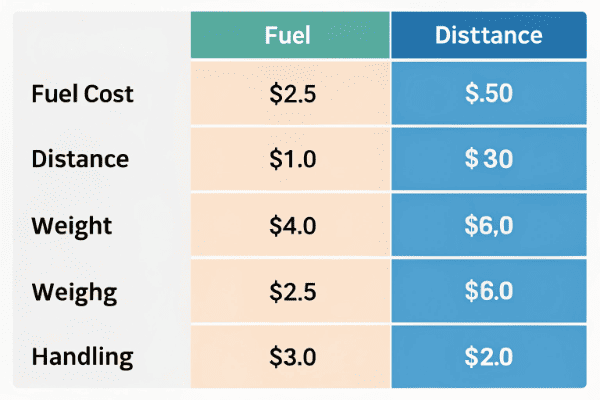
- Chargeable weight vs actual weight. Air and express always bill the heavier of the two. Dimensional cartons can double your air bill.
- Seasonality. Chinese New Year (late Jan/early Feb) and the run-up to Black Friday (Sept–Oct) push rates up 20–50%. Book 4–6 weeks ahead if you can.
- Fuel surcharge & currency. Airline fuel surcharges and GBP/USD/CNY moves shift the quote weekly.
- HS code & product type. Lithium batteries, magnets, liquids and foodstuffs are restricted or surcharged.
- Origin and destination. Shipments from Yiwu vs Shenzhen, or to a Highlands postcode vs central London, are not the same price.
- Port congestion. Felixstowe & Southampton booking windows can add 3–7 days; rail avoids this.
- Incoterms. FOB, EXW and CIF split costs between you and your supplier very differently. DDP removes the ambiguity — see Incoterms explained.
Real Client Examples (Names Changed)
Case 1 — Amazon FBA restock, 350 kg, sea LCL DDP
The cargo: printed promotional packaging, 350 kg / 1.8 CBM, Shenzhen to an Amazon fulfilment centre in Daventry.
The choice: Air would have been about £1,575 (350 kg × £4.50 DDP air) but arrived in 7–10 days; the client chose sea LCL DDP at £1.20/kg × 350 kg ≈ £420, plus a small CBM top-up. Goods left the factory on 14 July, cleared UK customs on 22 August, and were delivered to the FBA centre on 26 August — 43 days door-to-door.
Why it worked: The client had 8 weeks of stock cover, so sea's 70% cost saving beat air's speed.
Case 2 — Urgent retail order, 85 kg, air DDP
The cargo: consumer electronics accessories, 85 kg, Guangzhou to a distribution warehouse in Manchester.
The choice: A UK retailer needed stock in 10 days for a magazine launch. Toncentlink DDP air at £4.50/kg × 85 kg ≈ £383 all-in — duty and UK VAT included. Cargo was collected 2 April, departed SZX on 4 April, landed LHR on 8 April, and cleared into the Manchester warehouse on 10 April.
Why it worked: The magazine-driven sales justified the air premium; the DDP structure meant no phone calls from HMRC on day of delivery.
Case 3 — Mid-volume industrial parts, 8 CBM, rail DDP
The cargo: specialised valves, 8 CBM / 1,200 kg, Chengdu to Birmingham.
The choice: Sea would have been cheapest (~£1,400 all-in) but 35–45 days. Air would have been ~£5,400. Rail DDP at £2.80/kg × 1,200 kg = £3,360 landed in 21 days — 14 days faster than sea for about 2.4× the sea cost.
Why it worked: The client needed a steady replenishment rhythm; rail's predictable 20–22-day window let them plan stock weeks in advance.
How to Lower Your China→UK Shipping Bill
- Consolidate. Buy from multiple factories? We collect all orders into our Shenzhen warehouse, hold them, and ship as one LCL or FCL container. This usually beats per-supplier shipments by 30–50%.
- Plan for sea. The single biggest saving is choosing sea over air. Build your inventory plan 3–4 months ahead where possible.
- Right-size your packaging. Smaller cartons and dunnage instead of air reduce volumetric weight — especially for air and express.
- Use DDP, not port-to-port. It looks more expensive per kg on paper, but removes the surprise duty/VAT/brokerage bills that blow up margins.
- Avoid peak season. Shifting a 20-foot container from September to October can cost £400–£800 more.
- Get the HS code right once. A 30-minute classification check saves days at the border.
For more on choosing a partner, see how to choose the right freight forwarder from China to the UK or read our complete 2026 step-by-step importing guide.
Frequently Asked Questions
How much does it cost to ship from China to the UK by sea?
As of September 2026, sea freight from China to the UK runs roughly £2,050–£2,520 for a 20' container, £3,230–£3,950 for a 40'HQ, and £43–£118 per CBM for LCL. Toncentlink's LCL DDP door-to-door starts at £1.20/kg, with duty and UK VAT already included.
How much is air freight from China to the UK per kg?
Standard port-to-port air is around £3.50–£6.30/kg for 100 kg+ shipments. Door-to-door DDP air typically runs from £4.50/kg. Express courier (DHL/FedEx/UPS) is £5.50–£9.50/kg for 3–5 day delivery.
How long does shipping from China to the UK take?
Transit times in 2026: express 3–5 days, air 7–12 days door-to-door, rail 18–25 days, sea FCL 25–40 days, sea LCL 30–50 days. Red Sea rerouting can add 10–14 days to some sailings. For more detail see our shipping time China to the UK guide.
Do I pay UK VAT and duty on goods shipped from China?
Yes. UK import VAT is 20% on almost all consignments. Customs duty depends on your HS code and ranges 0–16%. Under DDP shipping, your forwarder's UK fiscal representative pays these at the border on your behalf — you do not receive a separate bill.
What is the £135 rule for parcels to the UK?
Consignments valued at £135 or less currently qualify for customs-duty relief (VAT still applies). HMRC announced in July 2026 that this relief will be removed over the next two years. If you send small parcels directly to UK consumers, plan for duty to become chargeable on low-value orders.
Which UK ports do China shipments arrive at?
Most direct sailings call at Felixstowe (the UK's largest container port), Southampton, London Gateway or Tilbury. Air freight arrives at Heathrow (LHR) or Manchester (MAN). Rail crosses via the Channel Tunnel after reaching Duisburg.
What is the cheapest way to ship from China to the UK?
For 15 CBM or more, FCL sea is the cheapest per CBM. For 1–15 CBM, LCL sea DDP at ~£1.20/kg beats air by 5–10×. For smaller or urgent shipments, DDP express is usually the most cost-effective door-to-door option. Rail is the best balance when you need sea-like pricing with air-like speed.
Do I need an EORI number to import from China?
If you use DDP shipping through Toncentlink, we use our own UK EORI and fiscal representation — you do not need one for the import leg. If you import on your own (port-to-port terms), you must hold a GB-prefixed EORI number before goods can clear customs.
How do I get an accurate quote for my shipment?
Send us: (1) product description and HS code if known, (2) weight and dimensions per carton, (3) number of cartons, (4) your supplier's city in China, and (5) your UK postcode. We will come back with an all-in DDP quote within 24 hours.
Get Your All-In China→UK Shipping Quote Today
Stop comparing apples-to-oranges quotes. Toncentlink has moved over £50 million of cargo to UK importers since 2017, with a 98.7% on-time delivery rate. Every quote includes factory pickup, export clearance, international carriage, UK customs entry, duty, VAT and final delivery to your door or FBA — one number, no surprises.
👉 Get a Free DDP Quote — Reply Within 24h
Rates above are September 2026 market references. Ocean and air prices fluctuate weekly with fuel, currency and capacity. For a firm number on your specific cargo, request a quote.