
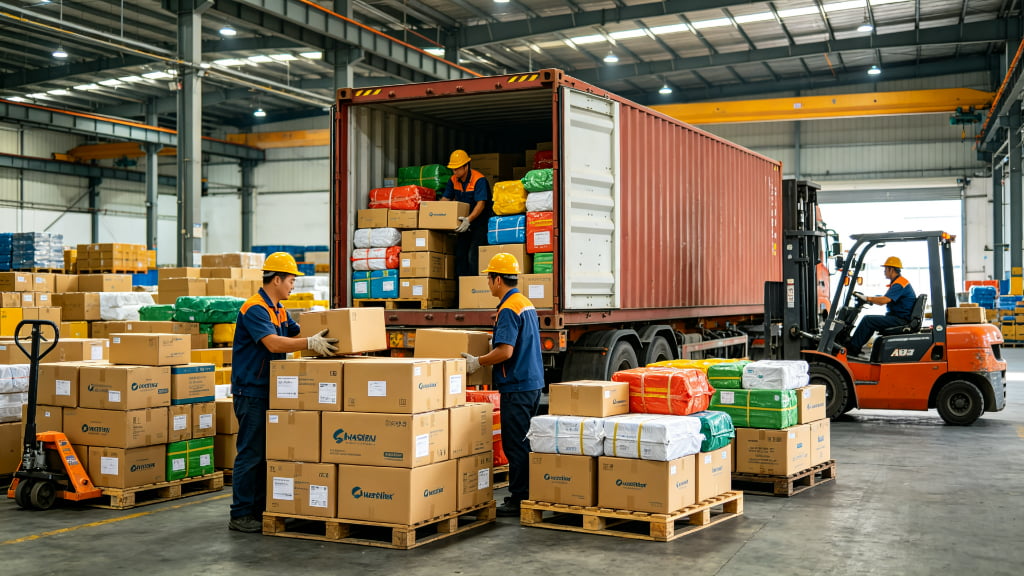
LCL (Less than Container Load) means your cargo shares a container with other shippers’ goods, and you pay only for the space your cargo occupies — measured in cubic meters (CBM). It is the right choice when your shipment is under ~15 CBM: above that volume, a full 20ft container (FCL) usually costs less per CBM and ships faster. In 2026, LCL ocean rates from China to the US range from $85–195/CBM depending on destination, but the base rate is only 50–60% of your total landed cost — origin and destination CFS fees, documentation, and customs charges make up the rest.
This guide explains exactly how LCL works, how the billing formula calculates your chargeable volume, the hidden fees that double your quote, and the precise break-even formula that tells you when to switch from LCL to FCL. Rate figures are based on 2026 Freightos Baltic Index (FBX) and Shanghai Shipping Exchange LCL benchmarks.
1. What Is LCL Shipping and How Does It Work?
LCL stands for Less than Container Load. Instead of booking an entire container, your forwarder consolidates your cargo with shipments from other sellers into one shared container at the origin port’s CFS (Container Freight Station). At the destination port, the container is opened and deconsolidated, and each shipper’s goods are released separately.
The LCL journey step by step:
- Origin pickup & CFS receiving: Your cargo is trucked from the factory to the forwarder’s consolidation warehouse (CFS). Allow 2–5 days.
- Consolidation: The forwarder waits until enough cargo from multiple shippers fills a container. This typically takes 3–7 days, but can stretch to 10–14 days in low-volume seasons or on niche routes.
- Ocean transit: The shared container sails to the destination port — same vessel and transit time as FCL.
- Destination deconsolidation: At the destination CFS, the container is unloaded and your cargo is separated. This takes 3–5 days.
- Customs & final delivery: Your shipment clears customs independently and is trucked to your warehouse or FBA center. Allow 2–5 days.
Total LCL door-to-door time: 35–50 days from China to the US — roughly 5–7 days slower than FCL because of the consolidation and deconsolidation steps.
2. How LCL Is Billed: The Chargeable Volume Formula
LCL is priced per CBM, but you are not always billed on your cargo’s physical volume. The industry uses a chargeable volume that takes both size and weight into account:
The standard LCL density ratio is 1 CBM = 1,000 kg. If your cargo is heavier than 1,000 kg per CBM, you are billed on weight instead of volume.
Example: A shipment of machine parts measures 2 CBM but weighs 3,200 kg.
Actual volume = 2 CBM | Weight-based volume = 3,200 ÷ 1,000 = 3.2 CBM
Chargeable volume = 3.2 CBM (the larger number), not 2 CBM.
Minimum billable volume: Most LCL forwarders charge a minimum of 0.5 CBM or 100 kg, whichever is greater. If your shipment is only 0.3 CBM / 50 kg, you still pay for 0.5 CBM. This makes very small shipments (<0.5 CBM) inefficient by LCL — air express or courier may be cheaper for those.
Full LCL Cost Breakdown (2026)
The per-CBM ocean rate is only part of the bill. A complete LCL quote includes these charges:
| Charge | Typical cost (2026) | Notes |
|---|---|---|
| Ocean freight (base) | $85–195 / CBM | China→US West $85–165; China→US East $110–195; China→EU $70–150 |
| Origin CFS handling | $35–75 / shipment | Warehouse receiving, labeling, consolidation |
| Destination CFS / deconsolidation | $45–95 / shipment | Unloading, separating cargo at destination port |
| BAF / CAF surcharges | 8–15% of base rate | Bunker Adjustment Factor / Currency Adjustment Factor |
| Documentation fee | $30–50 / shipment | Bill of lading, manifests |
| ISF filing (US only) | $30–50 / shipment | Importer Security Filing, due 24h before vessel departure |
| Customs bond (US) | $50–200 single / $400–800 annual | Required for formal entries over $2,500 |
| Customs clearance | $100–250 / shipment | Broker entry filing |
| Peak season surcharge | +15–28% | Aug–Nov, varies by carrier |
Key insight: The base ocean rate is typically only 50–60% of your total landed LCL cost. The remaining 40–50% comes from fixed per-shipment charges (CFS, docs, customs). This is why the per-CBM cost drops as your volume increases — the fixed fees get spread over more CBM.
3. LCL vs FCL: The Break-Even Formula
The decision between LCL and FCL comes down to one calculation. Do not rely on rules of thumb — compute it for your specific shipment:
If your cargo volume is below the break-even point → LCL is cheaper.
If your cargo volume is above the break-even point → FCL is cheaper.
Worked example (China → US West Coast, 2026 mid-year):
- FCL 20GP all-in price: $2,800
- LCL all-in rate: $140 / CBM
- Break-even = $2,800 ÷ $140 = 20 CBM
At 15 CBM: LCL = 15 × $140 = $2,100 (vs FCL $2,800) → LCL saves $700
At 20 CBM: LCL = 20 × $140 = $2,800 (vs FCL $2,800) → equal
At 25 CBM: LCL = 25 × $140 = $3,500 (vs FCL $2,800) → FCL saves $700
Volume-Based Decision Guide
| Cargo volume | Recommendation | Why |
|---|---|---|
| Under 0.5 CBM / under 100 kg | Air express or courier | LCL minimum charge makes it uneconomical |
| 0.5 – 10 CBM | LCL (clearly cheaper) | LCL saves 40–70% vs paying for a full container |
| 10 – 15 CBM | Get both LCL and FCL quotes | Break-even zone — compare total landed cost |
| 15 – 20 CBM | Usually FCL 20GP | Most routes favor FCL once destination fees are included |
| 25 – 30 CBM+ | FCL 20GP or 40GP | Compare 20GP vs 40GP pricing; 40HQ often best value per CBM |
Route variations: The break-even point shifts by destination. On Africa and South America routes, LCL per-CBM rates are higher, so FCL becomes cheaper at lower volumes (8–12 CBM). On near-sea routes to Southeast Asia, LCL stays competitive up to 10–14 CBM. Always request both quotes and compare the all-in landed cost, not just the ocean rate.
4. When Small Sellers Should Use LCL
LCL is the best fit for these scenarios:
- New sellers testing a product: Your first order of 2–5 CBM is perfect for LCL — no need to fill a container.
- Inventory restocks under 15 CBM: Regular top-up shipments that don’t justify a full container.
- Seasonal or low-volume SKUs: Products that sell steadily but don’t move enough volume for FCL.
- Multiple suppliers, one shipment: LCL forwarders can pick up from several factories and consolidate into one container, saving you coordination work.
- Cash flow constraints: LCL requires less upfront capital than booking a full container, and you only pay for the space you use.
- Urgent but not air-urgent: If air freight is too expensive but you don’t have enough for FCL, LCL is the middle ground.
5. The 4 LCL Pitfalls Small Sellers Miss
- Consolidation wait time: Your cargo may sit in the origin CFS warehouse for 7–14 days waiting for the container to fill. Always ask your forwarder for the consolidation cutoff date and estimated vessel departure — not just the transit time.
- Destination CFS fees: Some forwarders quote a low origin rate but charge high destination deconsolidation fees. Always ask for the full all-in landed cost, including destination charges, before booking.
- Damage risk from mixed cargo: Your goods share container space with other shippers’ cargo — including heavy or awkward items. Ensure your cargo is properly palletized and labeled, and confirm cargo insurance covers LCL shipments.
- Minimum charge trap: Shipments under 0.5 CBM still pay for 0.5 CBM. If you regularly ship very small quantities, compare LCL with air express — courier can be cheaper and faster for under ~30 kg.
6. LCL vs FCL at a Glance
| LCL (Less than Container Load) | FCL (Full Container Load) | |
|---|---|---|
| Pricing | Per CBM (chargeable volume) | Per container (flat rate) |
| Best for | Under ~15 CBM | Over ~15 CBM |
| Door-to-door time (China→US) | 35–50 days | 30–45 days |
| Container sharing | Yes — with other shippers | No — exclusive use |
| Damage risk | Slightly higher (mixed cargo) | Lower (sealed container) |
| Flexibility | Ship any volume | Must fill or pay for empty space |
| Customs | Each shipper clears separately | Single entry for the whole container |
FAQ
Q: What does LCL mean in shipping?
A: LCL stands for Less than Container Load. It means your cargo does not fill an entire shipping container, so it is consolidated with other shippers’ goods into one shared container. You pay only for the space your cargo occupies, measured in cubic meters (CBM), rather than paying for a full container.
Q: When should I use LCL instead of FCL?
A: Use LCL when your cargo is under approximately 15 CBM. The exact break-even point depends on your route and current rates — calculate it as: FCL all-in price ÷ LCL all-in rate per CBM. Below that volume, LCL is cheaper; above it, FCL costs less per CBM and ships 3–7 days faster.
Q: How is LCL shipping cost calculated?
A: LCL is billed on chargeable volume, which is the greater of your cargo’s actual volume (CBM) or its weight divided by 1,000 (1 CBM = 1,000 kg standard ratio). Most forwarders charge a minimum of 0.5 CBM. The total cost includes the base ocean rate per CBM plus fixed per-shipment fees: origin CFS handling ($35–75), destination deconsolidation ($45–95), documentation ($30–50), ISF filing ($30–50 for US), customs clearance ($100–250), and any peak season surcharges (15–28%).
Q: How long does LCL shipping take from China to the USA?
A: LCL door-to-door from China to the US takes 35–50 days. This includes 2–5 days for origin pickup, 3–7 days for consolidation at the CFS warehouse, 25–35 days of ocean transit, 3–5 days for destination deconsolidation, and 2–5 days for customs clearance and final delivery. It is typically 5–7 days slower than FCL because of the consolidation and deconsolidation steps.
Q: Is LCL cheaper than air freight for small shipments?
A: For cargo over ~0.5 CBM or 100 kg that is not time-sensitive, yes — LCL is significantly cheaper than air freight. LCL ocean rates are $85–195/CBM versus air freight at $5.50–7.50/kg. However, for very small shipments under 0.5 CBM or under ~30 kg, air express or courier may actually be cheaper and much faster (3–7 days vs 35–50 days) because of LCL’s minimum charge and long transit.
Get an All-In LCL Quote — No Hidden Fees
Toncentlink provides transparent LCL shipping from China to the US, Canada, Europe, and the UK — with full itemized quotes that include origin CFS, ocean freight, destination deconsolidation, customs clearance, and final delivery. No surprise charges after your cargo is on the water.
Get a free, no-obligation quote today.