Choose a reliable China freight forwarder by verifying five things in order: (1) check their licenses — business license, NVOCC, FMC OTI, and IATA membership; (2) demand evidence — 90-day shipping records, customer references, and a live video tour of their warehouse; (3) watch for quote traps — prices 20%+ below market, full upfront payment, or payment to a personal account are all red flags; (4) test their service capability — tracking system, customs clearance, and response speed; and (5) run a small trial shipment before committing large volume. Skip any forwarder that dodges these checks — in 2026, over 300 cases of fake or expired logistics licenses are reported at major Chinese ports every year, and the consequences range from hidden fees to total cargo loss.
This guide gives you a step-by-step vetting checklist, the exact red flags that signal a scam, and how to verify every credential using free official databases.
1. Verify Their Licenses (The Fastest Filter)
A legitimate freight forwarder can produce these documents within minutes. Refusal or deflection means walk away.
| Credential | What it proves | How to verify |
|---|---|---|
| Business License (营业执照) | Legally registered company in China | Search on National Enterprise Credit System (gsxt.gov.cn) using the company’s Chinese name |
| NVOCC License | Authorized to issue house bills of lading and book space directly with carriers (sea freight) | Ask for the registration number; verify against China Ministry of Transport public registry |
| FMC OTI License (US routes) | Legally authorized to operate China-to-USA ocean freight | Search the official FMC OTI database by company name — a 6-digit license number should appear |
| IATA Membership | Authorized to handle air freight bookings | Verify on IATA’s official member directory |
| CIFA Membership | Member of China’s national freight forwarders association | Check CIFA’s member directory |
| AEO Certification | Customs-certified operator — faster clearance, lower inspection rate | Ask for the AEO certificate number |
Key question to ask: “Are you an FMC-licensed NVOCC?” The safe answer is “Yes, here is our 6-digit FMC license number.” The red-flag answer is “We work with partners” or “We don’t need that for DDP.”
2. Demand Real Evidence (Not Just Claims)
Licenses are necessary but not sufficient — a licensed company can still be a bad operator. Demand tangible proof:
- 90-day shipping records: Ask for 2–3 recent bills of lading or customs declaration forms (with sensitive info redacted). This proves they actually move cargo on your trade lane, not just resell another forwarder’s service.
- Customer references: Request 2–3 clients in your industry or destination country. A real forwarder has references ready; a scammer goes silent.
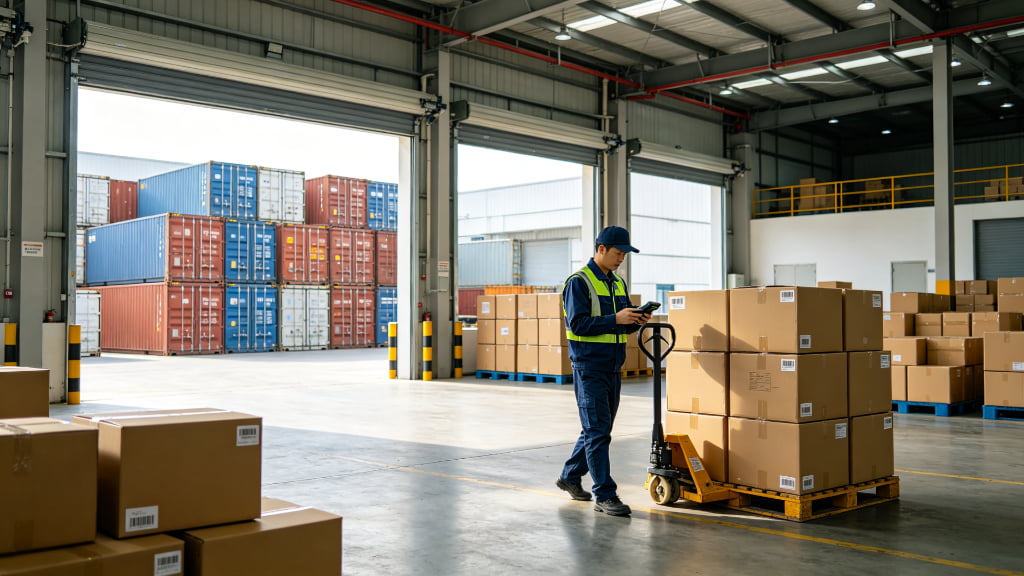
- Live warehouse video tour: Ask for a real-time video call (WeChat/WhatsApp) showing their warehouse, staff, and current cargo. Pre-recorded videos and stock photos can be faked — insist on live.
- Physical office address: Get the exact address and check it on Google Maps street view. A “virtual office” or residential address is a warning sign.
- Website domain age: Use a Whois tool to check when their domain was registered. A brand-new domain (under 6 months) combined with ultra-low prices is a high-risk profile.
3. Identify Quote Traps (7 Red Flags)
These are the most common scams and pricing traps in 2026:
| Red flag | What it means | What to do |
|---|---|---|
| Quote is 20%+ below all competitors | Hidden fees will be added after your cargo is in transit — you have no leverage once goods are on the water | Walk away; market rates cluster within ~10% of each other |
| Requires 100% upfront payment | Scam pattern — legitimate forwarders accept 30% deposit + 70% against bill of lading copy | Refuse; never pay full amount before cargo ships |
| Payment to a personal bank account | Fraud — company payments must go to a corporate account matching the business license name | Never pay to personal accounts |
| Vague “all-in” price with no itemization | Black-box pricing — terminal handling, customs, fuel surcharges will be billed later | Demand a line-item breakdown (ocean freight / port charges / customs / delivery) |
| Sudden change of bank details | Possible account takeover or scam — verify by phone before paying | Call your contact directly to confirm the change |
| Pressure to decide immediately | Scammers rush you so you skip verification | Take your time; a real forwarder won’t vanish if you wait 24 hours |
| Only communicates on personal apps (no business email) | Untraceable identity — if they disappear, you have no recourse | Require a company domain email and written contract |
The LCL trap: Some forwarders push LCL consolidation without warning that your goods may sit in a warehouse for 10–14 days waiting for other cargo to fill the container. Always ask for the consolidation cutoff and estimated departure date.
4. Evaluate Service Capability
Price and credentials matter, but day-to-day service determines whether your cargo arrives on time. Test these four areas:
- Tracking system: Do they provide an online portal where you can see vessel location, customs status, and estimated delivery? Or only WhatsApp updates? Digital dashboards are standard for professional forwarders in 2026.
- Customs clearance capability: Do they have their own customs broker or a licensed partner? Can they handle DDP (Delivered Duty Paid) with real importer-of-record service? Vague answers about “we handle customs” are not enough.
- Response speed: How fast do they reply before the sale? If it takes 2–3 days during the sales process, it will be worse during a crisis. Test with a technical question (e.g., “What is the HTS code for my product?”) and see if they answer accurately.
- Cargo insurance: Do they offer cargo insurance, and can they clearly state liability limits if goods are lost or damaged? Evasive insurance answers are a major red flag.
5. Run a Small Trial Shipment
Before committing a full container or monthly volume, send a trial shipment of 1–5 cartons via air or LCL. This tests:
- Actual transit time vs. promised time
- Documentation accuracy (commercial invoice, packing list, bill of lading)
- Customs clearance smoothness
- Problem resolution if something goes wrong
- Final total cost vs. quoted cost
A trial shipment costs a few hundred dollars but can save you tens of thousands in fraud losses or service failures.
Why Toncentlink Passes Every Check
- 10+ years focused on the China-to-USA market — we specialize in FBA, DDP, and FCL/LCL routes to the US, Canada, and Europe.
- Licensed and certified — NVOCC registered, with proper US route credentials.
- Real warehouse, real team — we welcome live video tours of our Shenzhen warehouse and operations center.
- Transparent itemized quotes — no hidden fees, no surprise charges. You see every cost line before you ship.
- Online tracking portal — monitor your shipment from pickup to final delivery in real time.
- Trial-friendly — start with a small shipment to verify our service before scaling.
FAQ
Q: What licenses should a reliable China freight forwarder have?
A: At minimum, a valid Chinese business license (营业执照) and an NVOCC registration from the Ministry of Transport for sea freight. For China-to-USA routes, verify they hold an FMC OTI license (6-digit number, searchable on the FMC official database). For air freight, check IATA membership. CIFA membership and AEO certification are additional markers of legitimacy.
Q: What are the biggest red flags when choosing a freight forwarder in China?
A: The top red flags are: (1) quotes 20%+ below market rate with no itemization; (2) requiring 100% upfront payment; (3) asking for payment to a personal bank account; (4) refusing to provide licenses or customer references; (5) no physical warehouse or only a virtual office address; (6) communicating exclusively through personal messaging apps with no business email; (7) pressuring you to decide immediately.
Q: How can I verify a Chinese freight forwarder is legitimate?
A: Verify in five steps: (1) check their business license on gsxt.gov.cn (National Enterprise Credit Information System); (2) confirm their NVOCC number with China’s Ministry of Transport; (3) search their company name in the FMC OTI database for US routes; (4) request a live video tour of their warehouse; (5) ask for 2-3 customer references and recent bills of lading. If they resist any of these, move on.
Q: Is it safe to pay a deposit to a Chinese freight forwarder?
A: Yes, if the payment goes to a corporate bank account matching the company name on the business license, and the terms are 30% deposit + 70% against the bill of lading copy. Never pay 100% upfront, never pay to a personal account, and always get a written contract or service agreement before sending money. If the forwarder suddenly changes bank details, verify by phone before paying.
Get a Transparent Quote from a Forwarder You Can Trust
Request a free, itemized quote from Toncentlink today. We will show you every cost line, provide our license numbers, and arrange a live warehouse tour — so you know exactly who is handling your cargo before you ship.
Get a free, no-obligation quote today.