
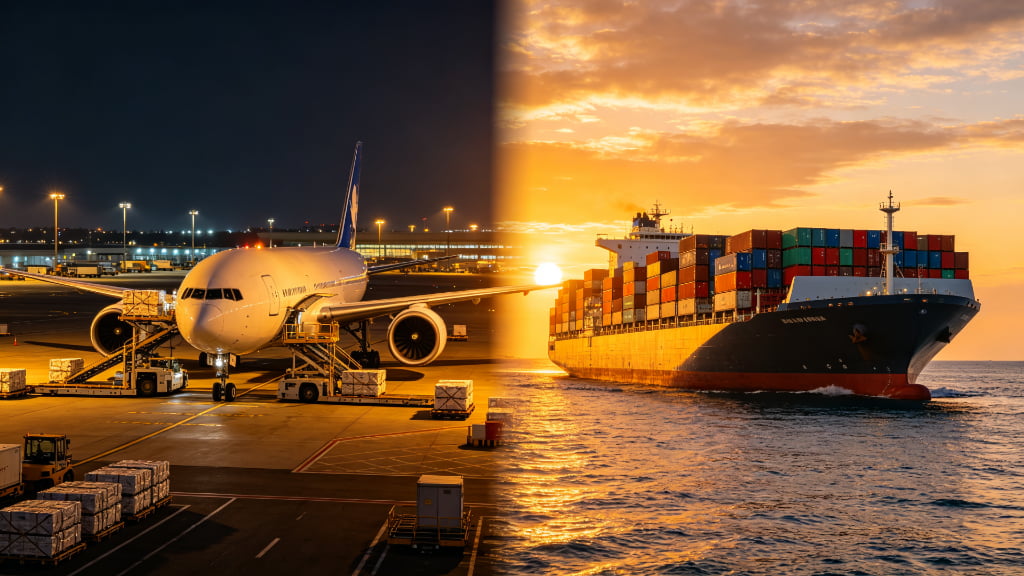
For Amazon sellers shipping from China, sea freight is better for planned inventory above 500 kg or 12–15 CBM (saves 50–60% vs air), while air freight is better for urgent restocks, high-value items, and shipments under ~300–500 kg. In 2026, air freight runs $5.5–7.5/kg (DDP, West Coast) with 7–12 day delivery, while LCL sea freight is $50–180/CBM with 16–35 day transit. The winning strategy for most sellers is a hybrid: ~70% sea + ~30% air.
This guide breaks down the real 2026 cost and transit-time numbers (based on Freightos Baltic Index ocean benchmarks and IATA air cargo rate data), the volumetric-weight trap that makes air freight 2–3x more expensive than it looks, and a simple decision rule so you never overpay or run out of stock.
1. Air Freight vs Sea Freight: The 2026 Comparison
| Dimension | Air Freight | Sea Freight (LCL/FCL) |
|---|---|---|
| Cost per kg | $5.5–7.5/kg (DDP West Coast); $6.5–9/kg (East Coast) | $2.1–5.8/kg equivalent; LCL $50–180/CBM |
| Transit time | 3–7 days airport-to-airport; 7–12 working days DDP door-to-door | 16–26 days LCL/FCL to West Coast; 25–35 days to East Coast |
| Billing basis | Higher of actual weight or volumetric weight (L×W×H cm ÷ 6000) | Per CBM (or per container for FCL) |
| Best for | Urgent restocks, high-value items, light/bulky goods, samples | Planned inventory, heavy cargo, large volume, low-margin products |
| Risk profile | Low delay risk; fuel surcharges | Port congestion, demurrage, seasonal rate spikes |
2. The Simple Decision Rule (2026)
Use these weight and volume thresholds to decide in under 60 seconds:
- Under 21 kg: Use express courier (DHL/FedEx/UPS) — $8–15/kg, 3–5 days. Convenience wins at this size.
- 21–150 kg: Air freight DDP — $5.5–7.5/kg, 7–12 days. Ideal for urgent restocks and time-sensitive products.
- 150–500 kg: Air freight is still competitive at $5–8/kg, but LCL sea freight becomes increasingly attractive if you can wait 16–26 days.
- Above 500 kg: Sea freight wins. Air freight becomes uneconomical, and LCL/FCL sea freight cuts your freight cost by 50–60%.
- Above 12–15 CBM: Switch from LCL to FCL (full container) — you stop paying consolidation and handling markups.
3. The Volumetric Weight Trap: Why Air Freight Costs 2–3x More Than You Think
Air freight is billed on chargeable weight = the higher of actual weight and volumetric weight:
Volumetric weight (kg) = Length (cm) × Width (cm) × Height (cm) ÷ 6000
Example: a carton of plush toys weighing 12 kg actual with dimensions 60×50×45 cm has a volumetric weight of 60×50×45 ÷ 6000 = 22.5 kg. You pay for 22.5 kg — nearly double the actual weight.
Three ways to reduce volumetric weight:
- Vacuum-compress packaging for clothing, textiles, and plush items — shrink volume by 40–60%.
- Right-size your cartons. A box that fits your product exactly avoids “big box, small item” penalties.
- Split into smaller boxes so actual weight and volumetric weight stay close.
4. When Sea Freight Is the Clear Winner
Sea freight carries over 90% of China–US trade volume for a reason: it is dramatically cheaper per unit. Key numbers for 2026:
- LCL (less than container load): $50–180/CBM, 16–26 days to the West Coast. Best for 2–12 CBM shipments.
- FCL 20ft: ~$1,650–2,300 (Shanghai→LA, port-to-port).
- FCL 40HQ: ~$3,500–5,000 West Coast off-peak; higher in Q4 peak season (8–11 months). A 40HQ holds ~68 CBM / 26–28 tons.
- Full DDP door-to-door: a 40HQ to the West Coast runs $5,900–6,700 including customs clearance and delivery to the Amazon fulfillment center.
Sea freight is the right choice when: your product is heavy or bulky, your profit margin is thin, you have a predictable sales forecast, and you can hold 4–6 weeks of buffer stock.
5. When Air Freight Justifies Its Premium
Air freight costs 3–6x more per kilogram than sea freight, but it earns its premium in these situations:
- Stockout rescue: A restock that arrives 3 weeks late can cost more in lost sales and Buy Box rank than the air freight premium.
- Product launches: Testing a new ASIN’s demand before committing to a container.
- High-value, low-weight products: Electronics, supplements, and accessories where the product margin absorbs the freight cost.
- Peak season windows: When an FBA delivery appointment or a promotion date is immovable, air is the only option that fits.
2026 air freight reference rates: airport-to-airport $3.5–7.5/kg; air DDP (air + customs + last-mile) $5.5–7.5/kg West Coast and $6.5–9/kg East Coast, 7–12 working days door-to-door. Direct flights (e.g., Shenzhen/Shanghai → LAX) cost $1–2/kg more than trans-shipment routes via Seoul or Tokyo but arrive 1–2 days faster.
6. The Hybrid Strategy: How Pros Save ~22%
Most successful Amazon sellers do not choose one method — they split inventory:
- ~70% by sea freight: Base inventory with a 25–35 day lead time.
- ~30% by air freight: Replenishment for fast-selling SKUs and buffer stock.
This hybrid approach cuts total freight cost by roughly 22% compared to an air-only strategy while maintaining a 95%+ fulfillment rate. It also protects you from both stockouts (air leg) and cash-flow strain (sea leg).
7. Hidden Costs to Watch in 2026
- Air: Fuel surcharges moved up 15–20% when oil spiked; Q4 peak-season space premiums of 15–20%.
- Sea: Port congestion at LA/LB, demurrage & detention fees, CET inspection fees, and chassis fees can erase your savings if not quoted up front. Always ask for an all-in DDP quote.
- Tariffs: Section 301 tariffs still apply to many product categories from China. A DDP price that includes duty and clearance removes the surprise.
FAQ
Q: Is air freight or sea freight cheaper from China to the USA in 2026?
A: Sea freight is 50–60% cheaper. Air freight runs $5.5–7.5/kg (DDP, West Coast) while LCL sea freight is $50–180/CBM (~$2.1–5.8/kg equivalent). For shipments above 500 kg or 12–15 CBM, sea freight is the clear cost winner.
Q: How much faster is air freight than sea freight?
A: Air freight takes 3–7 days airport-to-airport (7–12 working days DDP door-to-door), while sea freight takes 16–26 days to the U.S. West Coast and 25–35 days to the East Coast. Air is roughly 3–4 weeks faster.
Q: Can I combine air and sea freight for Amazon FBA?
A: Yes — the hybrid strategy (about 70% sea for base inventory + 30% air for fast movers) is the most cost-effective approach. It reduces total freight cost by roughly 22% versus air-only while keeping a 95%+ fulfillment rate.
Q: Why is my air freight bill higher than the quoted $/kg?
A: Air freight is billed on chargeable weight — the higher of actual weight and volumetric weight (L×W×H cm ÷ 6000). Light but bulky goods can be charged at 2–3x their actual weight. Compressing packaging and right-sizing cartons lowers the bill.
Ready to Ship Smarter?
Toncentlink offers both air and sea freight with competitive contract rates on major airlines and shipping lines, plus DDP customs clearance and last-mile delivery to Amazon fulfillment centers. Get a side-by-side air vs sea quote today.
Get a free, no-obligation quote today.