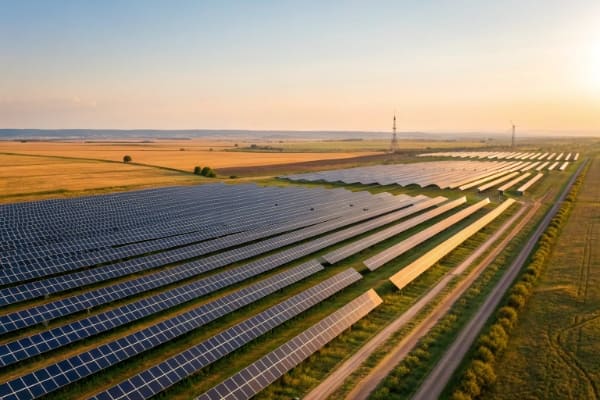
Confused by the complex tech in large solar farms? Misunderstanding the components can lead to costly mistakes. I'll explain the essential technologies that power these massive energy projects.
Utility-scale solar plants primarily use photovoltaic (PV) panels1, like crystalline silicon2 or thin-film, to convert sunlight into DC electricity. This power is then converted to AC by inverters3, managed by trackers and monitoring systems, and sent to the grid via transformers4 and substations5.
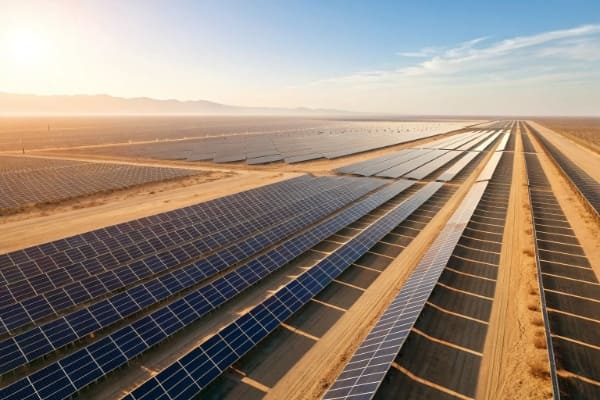
That's the big picture, but the real magic is in the details. Each component plays a critical role in turning sunlight into the power that runs our cities. To really understand how it all comes together, we need to look at the specific equipment that forms the backbone of any solar farm. Let's dive into the essential hardware first.
What Equipment Is Used in Utility-Scale Solar Projects?
Wondering what hardware makes a solar farm work? Focusing only on panels ignores the crucial systems that generate and deliver electricity. Here’s a list of the essential equipment involved.
Key equipment includes solar panels (modules) to capture sunlight, inverters3 to convert DC to AC power, and mounting systems or trackers to hold panels. Additionally, transformers4, switchgear, and substations5 are needed to step up the voltage and connect the plant to the electrical grid.
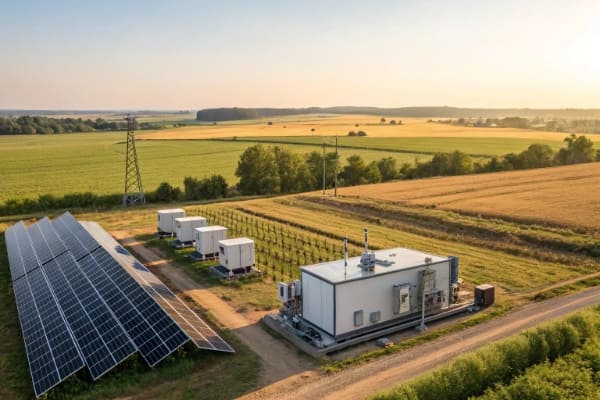
Beyond the main components, a utility-scale solar project is a complex ecosystem of interconnected hardware. Each piece is vital for performance, safety, and grid integration6. Think of it like a factory floor where every machine has a specific job. For example, combiner boxes collect the DC output from multiple strings of panels before sending it to the inverter. We also use sophisticated monitoring systems, known as SCADA (Supervisory Control and Data Acquisition)7, to track performance in real-time. This allows operators to spot issues and optimize output remotely. Here is a breakdown of the core equipment and its function:
| Equipment | Primary Function |
|---|---|
| Solar Panels | Convert sunlight into direct current (DC) electricity. |
| Inverters | Convert DC electricity into alternating current (AC). |
| Mounting/Trackers | Physically support panels and orient them toward the sun. |
| Transformers | Increase voltage for efficient long-distance transmission. |
| Substation | Connects the solar plant to the high-voltage power grid. |
| SCADA System | Monitors and controls the entire plant's operations. |
What Types of Solar Panels Are Used in Solar Farms?
Think all solar panels are created equal? Choosing the wrong type for a large project can cripple its efficiency and hurt your return on investment. Let's explore the dominant panel technologies.
The two main types are crystalline silicon2 (c-Si) and thin-film. Crystalline silicon, including monocrystalline and polycrystalline, is the most common due to its high efficiency. Cadmium telluride (CdTe)8 thin-film panels are also widely used for their cost-effectiveness9 in large-scale deployments.
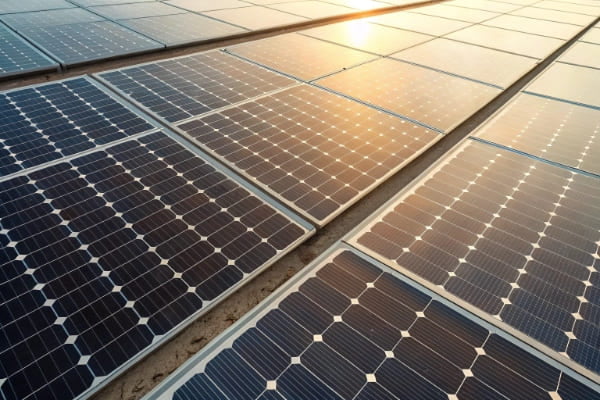
The choice of solar panel technology is one of the most important decisions in a utility-scale project. It directly impacts land use, cost, and overall energy yield10. For years, I've seen clients weigh the pros and cons of each type. Crystalline silicon has long been the market leader because it packs more power into a smaller space. However, recent innovations are changing the game.
Emerging High-Efficiency Technologies
Two newer technologies are becoming standard: PERC (Passivated Emitter and Rear Cell) and Bifacial modules. PERC cells add a special layer to the back of the panel, which reflects light back into the cell for a second chance at absorption, boosting efficiency. Bifacial panels can generate power from both sides, capturing reflected light from the ground. When combined with trackers, this can significantly increase a plant's total energy output, making them a popular choice for new projects.
What Are Solar Inverters and Why Are They Important?
Solar panels generate DC power, but the grid needs AC. Without a bridge, the energy is useless and wasted. Inverters are the critical component that solves this fundamental problem.
Solar inverters3 are the brains of a solar power plant. Their primary job is to convert the direct current (DC) electricity produced by solar panels into alternating current (AC) electricity that can be fed into the utility grid. They are essential for making solar energy usable.
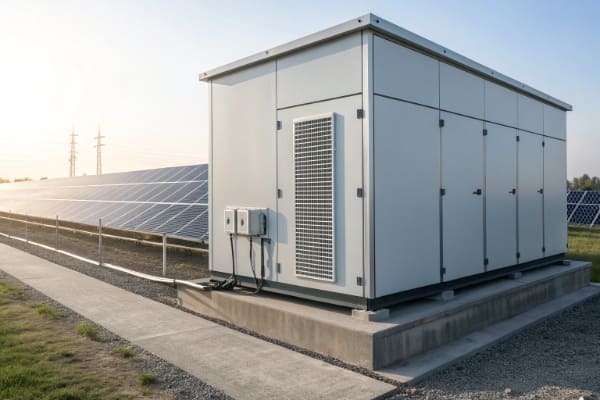
In my experience sourcing components for energy projects, the inverter is often called the "heart" of the system. Its role goes far beyond simple DC-to-AC conversion. Inverters also manage the system's performance, optimize power output, and ensure the electricity fed into the grid meets strict voltage and frequency standards. For large solar farms, there are two main types of inverters3 we deal with.
Central vs. String Inverters
Most utility-scale plants use centralized inverters3. These are large, single units that can handle massive amounts of power from thousands of panels. They are cost-effective and easier to maintain in a large field. In contrast, string inverters3 are smaller and manage smaller groups, or "strings," of panels. While less common in huge farms, they offer more granular control. The choice depends on the project's design, budget, and maintenance strategy, but central inverters3 remain the go-to for most large-scale applications.
How Do Solar Trackers Increase Energy Production?
Fixed solar panels miss a lot of sunlight as the sun moves. This inefficiency wastes potential energy and increases project costs. Solar trackers solve this by following the sun all day.
Solar trackers are mounting systems that orient solar panels toward the sun as it moves across the sky. By continuously adjusting the panels' angle, they maximize direct sunlight exposure, which can increase a solar farm's total energy production by 15% to 25% compared to fixed-tilt systems.
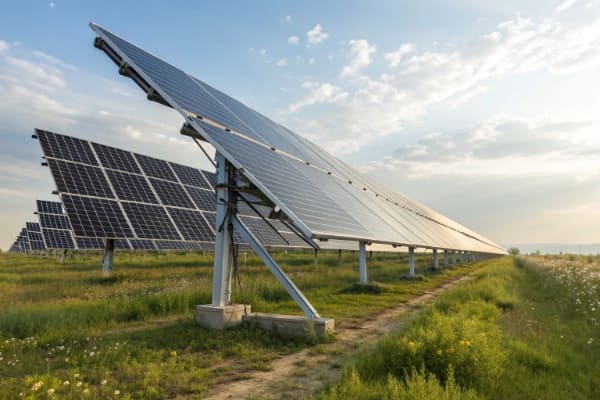
The goal of any solar farm is to get the most kilowatt-hours out of every panel. Solar trackers are a powerful tool to achieve this. Instead of letting panels sit flat, trackers use motors and sensors to tilt and turn them throughout the day. This simple act of following the sun has a huge impact on the bottom line. It means the plant generates more power during the valuable peak and shoulder hours of the day.
Single-Axis vs. Dual-Axis Trackers
There are two main types of trackers we typically source for clients:
| Tracker Type | Movement | Energy Gain (Typical) | Cost & Complexity |
|---|---|---|---|
| Single-Axis | Moves on one axis, usually east to west. | 15-25% | Lower |
| Dual-Axis | Moves on two axes, east-west and north-south. | 30-45% | Higher |
While dual-axis trackers11 capture more energy, single-axis trackers12 are the most common choice for utility-scale projects because they offer the best balance of performance gain and cost.
What Role Do Transformers and Substations Play?
Power from a solar plant is at the wrong voltage for the grid. Transmitting it directly would waste huge amounts of energy. Transformers and substations5 solve this critical transmission problem.
Transformers "step up" the low-voltage AC electricity from the inverters3 to a very high voltage suitable for long-distance transmission. A substation houses this equipment and serves as the connection point, safely feeding the solar energy into the regional or national high-voltage power grid.
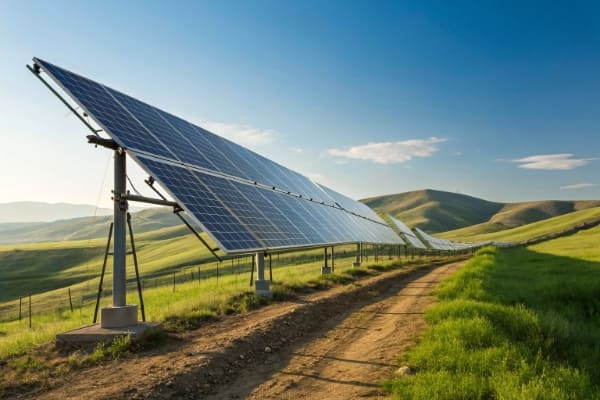
After the inverters3 do their job, the electricity is ready, but it's not strong enough for the long trip to cities and towns. This is where the heavy-duty electrical engineering comes in. The main reason we need to increase the voltage is to reduce energy loss. According to the laws of physics, power loss during transmission is proportional to the square of the current. By using a transformer to increase the voltage, we can decrease the current, which drastically cuts down on the energy that is lost as heat in the power lines.
The Gateway to the Grid
The substation is the final gateway. It’s a secure facility that contains not just transformers4 but also circuit breakers, switches, and monitoring equipment. It ensures the power flowing from the solar farm is stable and synchronized with the grid's frequency. For very large or remote solar farms, sometimes High-Voltage DC (HVDC) transmission lines are used, as they are even more efficient for moving massive amounts of power over very long distances.
How Do Battery Storage Systems Work with Solar Farms?
Solar farms only generate power when the sun shines. This intermittency makes them unreliable for 24/7 power needs. Battery storage solves this problem by saving solar energy for later.
Battery energy storage systems (BESS)13 are co-located with solar farms to store excess electricity generated during peak sun hours. This stored energy can then be discharged back to the grid during the evening, on cloudy days, or whenever energy demand is high, ensuring a stable power supply.
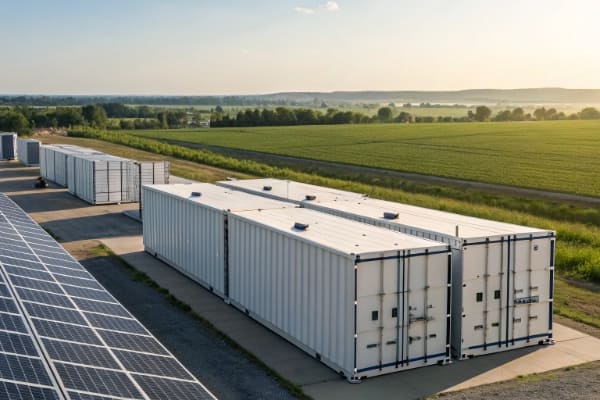
Adding batteries to a solar farm transforms it from a simple power generator into a reliable, dispatchable energy asset. I've seen this firsthand with clients who are now able to sell power when it's most valuable, not just when it's produced. The process is straightforward: during the day, any solar energy not immediately needed by the grid is used to charge large banks of batteries. When the sun goes down, the batteries release that stored power.
More Than Just Storage
But batteries do more than just time-shift energy. They also help stabilize the grid. They can respond in milliseconds to fluctuations in supply and demand, a service known as frequency regulation. This helps grid operators maintain a smooth and reliable flow of electricity. Most modern utility-scale storage systems use lithium-ion batteries14, similar to those in electric vehicles but on a massive scale, because of their efficiency and falling costs.
How Efficient Are Modern Utility-Scale Solar Technologies?
Many people think solar panels are still inefficient. This old belief holds back investment in today's powerful and affordable solar technology. Let's look at how efficient modern systems really are.
Modern utility-scale solar panels, like monocrystalline PERC or bifacial modules, typically have efficiencies between 20% and 23%. While this number refers to the panel itself, the overall plant efficiency, considering inverters3, wiring, and other losses, is slightly lower but continuously improving with technology.
When we talk about efficiency, it's important to be clear. A panel's efficiency rating measures how much of the sunlight hitting its surface is converted into electricity. Today's top-tier commercial panels are pushing 23%, a huge leap from the 15% standard just a decade ago. But that's only part of the story. The true measure of a plant's performance is its performance ratio15, which accounts for all system losses—from inverter conversion to dust on the panels. Modern plants achieve performance ratio15s of 80% or higher.
Beyond Photovoltaics: CSP Technology
It's also worth mentioning another utility-scale technology: Concentrating Solar Power (CSP)16. Instead of using PV panels, CSP systems use mirrors to concentrate sunlight to heat a fluid, which then creates steam to drive a turbine. While less common than PV, technologies like parabolic troughs and power towers17 can store heat, allowing them to generate electricity even after sunset.
Conclusion
From advanced panels and trackers to inverters3 and batteries, modern solar farms combine multiple technologies to deliver clean, reliable, and increasingly efficient power to the grid on a massive scale.
Explore how PV panels convert sunlight into electricity, a fundamental technology in solar energy. ↩
Learn about the most common solar panel material and its efficiency benefits. ↩
Understand how inverters convert DC to AC power, making solar energy usable. ↩
Discover how transformers increase voltage for efficient energy transmission. ↩
Find out how substations connect solar plants to the power grid. ↩
Understand the importance of integrating solar power into the electrical grid. ↩
Learn about SCADA systems that optimize solar plant performance in real-time. ↩
Explore the cost-effectiveness of CdTe panels in large-scale solar projects. ↩
Learn how cost considerations affect the choice of solar technologies. ↩
Explore the key elements that influence the energy output of solar projects. ↩
Explore the advantages of dual-axis trackers for maximizing solar energy. ↩
Understand how single-axis trackers enhance energy production in solar farms. ↩
Learn how BESS enhances the reliability of solar energy supply. ↩
Discover the efficiency and cost benefits of lithium-ion technology in solar. ↩
Understand how performance ratios measure the efficiency of solar plants. ↩
Explore an alternative solar technology that uses mirrors to generate electricity. ↩
Discover how power towers utilize sunlight to produce steam for electricity. ↩