
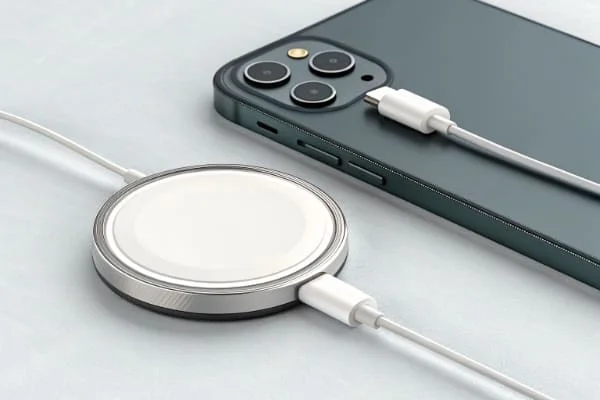
Struggling with messy cables and slow wireless charging? You need a better solution that is both simple and reliable for your customers and your brand.
"MagSafe compatible1" means an accessory uses magnets to align perfectly with an iPhone's internal magnetic ring. This ensures a secure connection for fast wireless charging and easy attachment of accessories like wallets or mounts, without needing official Apple certification.

I remember when I first started sourcing these accessories for clients. The terms were confusing. "MagSafe," "MagSafe Compatible," "Qi Charging2"... it was a mess. But understanding the difference is key to sourcing quality products that your customers will love. Let's break it down so you can make the best choice for your business and avoid costly mistakes.
Why Did Apple Create MagSafe in the First Place?
Tired of fumbling with charging pads just to find the sweet spot? Apple saw this user frustration and created a system that just clicks into place, every time.
Apple created MagSafe to solve two main problems with standard Qi wireless charging: poor alignment and slow speeds. The magnets ensure a perfect connection for faster, more efficient charging and open up a new ecosystem of easy-to-attach magnetic accessories.
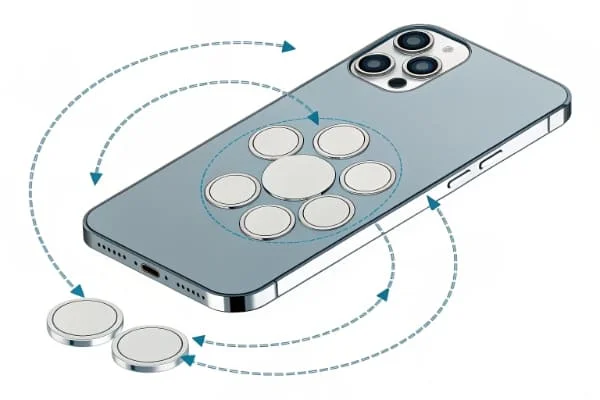
This innovation wasn't just about charging; it was a strategic move by Apple to create a new, proprietary ecosystem. By embedding a ring of magnets into the iPhone 12 and later models, they established a new standard. This standard solved the biggest user complaint about wireless charging: waking up to a phone that didn't charge because it was slightly off-center on the pad. The magnetic "snap" provides both a physical and an audible confirmation that charging has begun correctly. This reliability is something customers value highly. Furthermore, it created a platform for a whole new category of products. It was no longer just about power; it was about modularity3. You can snap on a wallet for the day, a car mount for your commute, or a stand for watching videos, all using the same magnetic interface. This created a huge market for third-party accessory makers4, which is where we, as sourcing experts, come in to help brands find reliable products.
What Is the Real Difference Between MagSafe and MagSafe Compatible?
Confused by the different labels on accessories? Choosing the wrong one can lead to slow charging speeds5 and unhappy customers who leave negative reviews6. Let's clear up the confusion.
The key difference is certification. "Made for MagSafe7" (MFM) accessories contain an official Apple module and are certified to deliver 15W charging. "MagSafe Compatible" accessories simply use magnets to align with the iPhone but are not certified and typically charge at slower 7.5W Qi speeds.
For my clients, this is the most important distinction to understand before placing a bulk order8. "Made for MagSafe7" (MFM) is a certification program. To get this badge on your product's packaging, a manufacturer has to use an official Apple-supplied MagSafe module and pass rigorous testing. This guarantees 15W fast charging and perfect performance. However, this comes at a higher cost, both for the manufacturer and the end consumer. "MagSafe Compatible," on the other hand, is an open-ended term. Any factory can produce an accessory with a ring of magnets that aligns with the iPhone. These products do not have Apple's official chip, so they are limited to the standard Qi wireless charging speed of 7.5W. While the connection is still secure, the charging is slower.
MFM vs. Compatible: A Quick Breakdown
| Feature | Made for MagSafe7 (MFM) | MagSafe Compatible |
|---|---|---|
| Certification | Official Apple Certification | No official certification |
| Max Charging Speed | Up to 15W | Typically 7.5W (Standard Qi) |
| Cost | Higher | Lower |
| Performance | Guaranteed by Apple | Varies by manufacturer |
| Identifier | "Made for MagSafe7" logo | "MagSafe Compatible" text |
For many businesses, "MagSafe Compatible" is the sweet spot. It offers the magnetic convenience customers love at a much more competitive price point. The key is to source from a reliable factory that uses strong magnets and quality charging coils9, which requires a solid quality control process10.
How Do You Choose a Truly Reliable MagSafe Compatible Charger?
Worried about sourcing a weak charger that drops your customer's phone or charges too slowly? Sourcing unreliable products can quickly damage your brand's reputation.
To choose a reliable charger, look for strong N52 magnets11 for a secure hold. Ensure it supports the Qi charging standard (or the newer Qi2 standard12 for future-proofing). Check for safety certifications13 and partner with a supplier who performs quality control inspections for heat and speed.
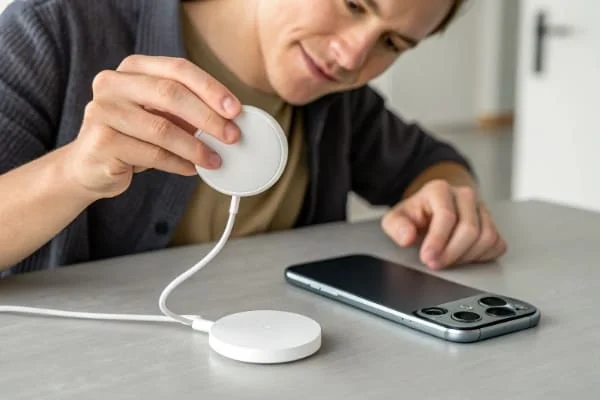
When I work with clients looking to source "MagSafe Compatible" chargers, I have a strict checklist we follow. First, we test the magnet strength. The accessory must hold the iPhone securely, even when shaken lightly. We look for suppliers using high-grade N52 neodymium magnets as a baseline. Second, we examine the charging coil and PCBA. A poorly made coil will lead to slow charging and, worse, overheating, which is a safety risk and a liability. We insist on pre-shipment inspections to test charging efficiency14 and temperature. Third, check for basic safety certifications13 like CE, FCC, and RoHS. These show the product meets international safety standards. Finally, the introduction of the new Qi2 standard12 is a game-changer. Qi2 incorporates Apple's magnetic profile into the universal Qi standard, allowing non-MFM chargers to achieve 15W speeds. When sourcing now, I advise my clients to prioritize suppliers who are Qi2 certified. This is the future of "MagSafe Compatible" and guarantees performance without the high cost of Apple's MFM program.
Which iPhones Support MagSafe and MagSafe Compatible Accessories?
Are you unsure which phones your new accessory will work with? Selling a product with the wrong compatibility information leads to customer frustration, returns, and bad reviews.
MagSafe and MagSafe compatible1 accessories are designed for the iPhone 12 series15 and all newer models. This includes the iPhone 12, 13, 14, 15, and all their variants (Mini, Pro, Pro Max). Older iPhones do not have the built-in magnetic ring.

It's a simple answer, but one that causes a lot of confusion for consumers. The MagSafe feature was introduced with the iPhone 12. Therefore, any iPhone model from the iPhone 12 series15 onward has the necessary internal magnetic array to work seamlessly with both official MagSafe and MagSafe compatible accessories. Older models, like the iPhone 11 or iPhone SE, support standard Qi wireless charging but lack the magnets for alignment and attachment.
iPhone MagSafe Compatibility Chart
| iPhone Model Series | MagSafe Support (Built-in) |
|---|---|
| iPhone 15 Series (15, Plus, Pro, Pro Max) | Yes |
| iPhone 14 Series (14, Plus, Pro, Pro Max) | Yes |
| iPhone 13 Series (13, Mini, Pro, Pro Max) | Yes |
| iPhone 12 Series (12, Mini, Pro, Pro Max) | Yes |
| iPhone 11 Series & Older | No |
However, there's a workaround for older phones that many sellers leverage. You can source and sell "MagSafe adapter cases16" or simple stick-on magnetic rings. These products add a magnetic ring to the outside of an older iPhone or a non-MagSafe case. While this enables the magnetic connection for mounts and wallets, it doesn't enable the faster 15W MagSafe charging speeds5. It's purely for the convenience of magnetic attachment. For e-commerce sellers, offering these adapter rings can be a smart way to expand your target market to include users of older iPhone models.
Is MagSafe Compatible Worth It Compared to Official MagSafe?
Is the high price of official MagSafe accessories holding you back? You might be missing out on a huge market by not considering more affordable and innovative alternatives.
For most businesses and consumers, MagSafe compatible1 accessories are absolutely worth it. They offer the same magnetic convenience and a vast array of designs at a fraction of the cost. While charging may be slower, the value and versatility often outweigh the speed difference.
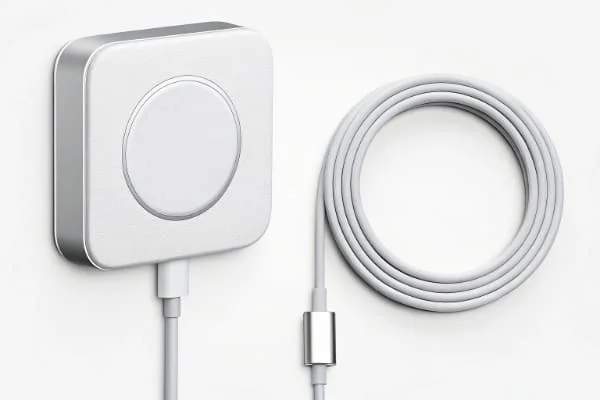
This is the big question for any brand owner or importer. The answer depends entirely on your target market and brand positioning. If you're building a premium brand and your customers expect the absolute best performance, investing in "Made for MagSafe7" (MFM) certification might be the right move. It provides a guarantee of 15W charging speed and carries the trust of the Apple brand. However, for the vast majority of businesses, "MagSafe Compatible" presents a much larger opportunity.
Weighing the Options: MagSafe Compatible
Pros:
- Lower Cost: This is the most significant advantage. It allows for competitive retail pricing and higher profit margins for your business.
- Wider Variety: The market is flooded with innovative designs for compatible accessories, from multi-device charging stands to unique car mounts, far beyond what Apple offers.
- Sufficient Performance: For accessories like wallets, stands, or car mounts, charging speed is irrelevant. For chargers, 7.5W is often "good enough" for overnight charging or topping up at a desk.
Cons:
- Slower Charging: Without MFM or Qi2 certification, you're limited to 7.5W.
- Quality Varies: The market has great products and terrible ones. This is why working with a sourcing partner who does on-site quality control is non-negotiable.
Ultimately, "MagSafe Compatible" is worth it if you do your homework. By partnering with a reliable sourcing agent, you can find high-quality products that offer 90% of the functionality at 30-50% of the cost.
Conclusion
In short, "MagSafe compatible1" offers magnetic convenience at a great price. For the best of both worlds, look for new Qi2-certified products for fast charging without the official Apple tax.
Understanding this term is crucial for sourcing quality accessories that align with iPhone models. ↩
Explore the technology behind Qi charging to better understand its benefits and limitations. ↩
Discover how modularity enhances user experience and product versatility. ↩
Explore the advantages of sourcing from third-party manufacturers for unique products. ↩
Explore the elements that influence charging speeds to make informed sourcing decisions. ↩
Learn effective strategies to manage and respond to negative reviews. ↩
Learn about this certification to ensure you source high-quality, reliable accessories. ↩
Get insights on best practices for bulk ordering to avoid costly mistakes. ↩
Understanding charging coils is essential for ensuring product quality and performance. ↩
Learn about quality control processes to ensure the reliability of sourced products. ↩
Discover the significance of N52 magnets in ensuring a secure connection for chargers. ↩
Learn about the advancements in wireless charging technology with Qi2. ↩
Understanding safety certifications helps ensure the products you source are safe for consumers. ↩
Find tips on enhancing charging efficiency to boost customer satisfaction. ↩
Get clarity on iPhone models that support MagSafe technology for better marketing. ↩
Discover how adapter cases can expand your market to older iPhone models. ↩