
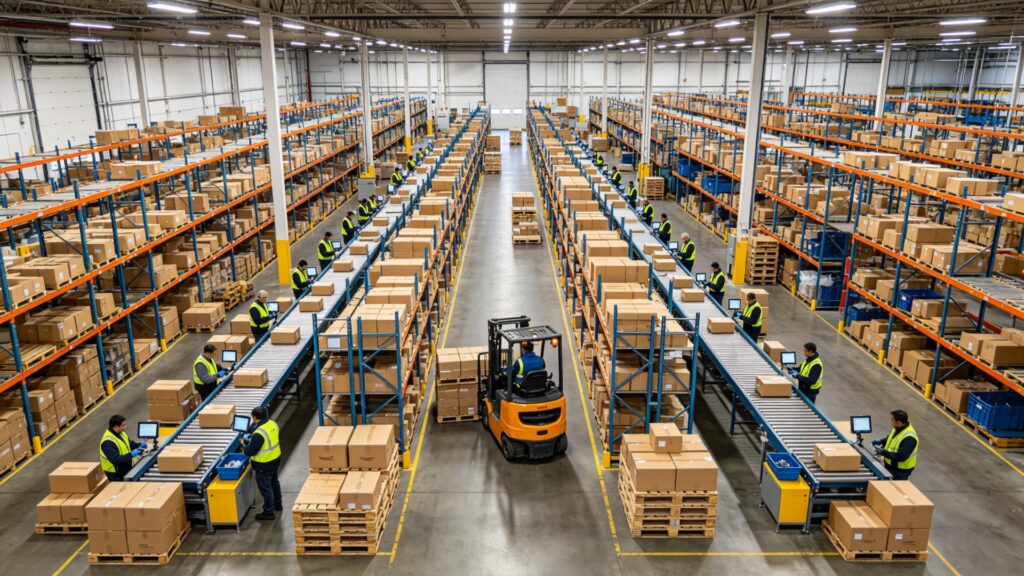
Shipping products from China to Amazon FBA takes five steps: prepare and label your inventory → choose a first-leg shipping method (sea freight 25–35 days, air freight 5–7 days, or express 3–5 days) → clear U.S. customs → book a delivery appointment with the Amazon fulfillment center → deliver and check in. Most sellers use DDP (Delivered Duty Paid) because Amazon cannot act as importer of record. A 40HQ container holds ~68 CBM and costs $5,900–$6,700 to the U.S. West Coast, while air freight runs $35–55/kg for urgent restocks.
If you are new to FBA or switching freight forwarders, this step-by-step guide covers the full process, current 2026 rates, Amazon’s strict inbound requirements (sourced from Amazon Seller Central’s official FBA inventory placement and prep requirements), and the three mistakes that cause delays or extra fees.
1. The 5-Step Process: China to Amazon FBA
Step 1: Prepare and Label Your Inventory
Before anything ships, every unit must be ready for Amazon’s barcode-driven receiving system:
- Product labels (FNSKU): Each unit needs an Amazon FNSKU barcode label. You can print and apply them yourself, use the FBA Label Service (per-unit fee), or qualify for FBA virtual tracking (stickerless commingled inventory).
- Cover original barcodes: Any UPC/EAN on the packaging must be covered so only the FNSKU is scannable.
- Polybag and prep: Items that need polybagging, bubble wrap, or warning labels must be prepped before shipping. Use only Amazon-approved dunnage (bubble wrap, air pillows, full sheets of paper)—not packing peanuts or shredded paper.
- Carton labels: Every outer carton needs a unique FBA Box ID label printed from your Shipping Queue in Seller Central.
Step 2: Choose Your First-Leg Shipping Method
From China to U.S. Amazon warehouses, you have three main options:
| Method | Transit Time | Typical Cost | Best For |
|---|---|---|---|
| Sea Freight (FCL/LCL) | 25–35 days | $15–25/kg equivalent; 40HQ $5,900–$6,700 to West Coast | Planned inventory restocks, large volumes |
| Air Freight | 5–7 days | $35–55/kg | Urgent restocks, high-value goods |
| Express (DHL/FedEx/UPS) | 3–5 days | $80–120/kg | Samples, small emergency shipments |
Most sellers use a hybrid strategy: 70% sea freight for planned inventory + 30% air freight for urgent orders. This reduces overall cost by ~22% while maintaining a 95%+ fulfillment rate.
Step 3: Clear U.S. Customs
Amazon cannot act as importer of record (IOR), so you or your forwarder must clear customs. Key requirements:
- DDP vs DDU: DDP means your forwarder pays duty, taxes, and clearance—one all-in price. DDU means you receive a separate duty invoice. Most FBA sellers prefer DDP for predictability.
- Documents: Commercial invoice, packing list, bill of lading/air waybill, and ISF (Importer Security Filing, “10+2”) must be filed at least 24 hours before the vessel sails. Late ISF filing can result in fines up to $5,000.
- Customs bond: Required for entries valued over $2,500.
Step 4: Book an Amazon Fulfillment Center Appointment
For LTL/FTL (less-than-truckload / full-truckload) deliveries, your carrier must schedule a dock appointment at least 24 hours before delivery. The carrier needs the PRO number, BOL number, all PO numbers, and total pallet/carton counts. Small parcel shipments (UPS/FedEx) do not require an appointment.
Step 5: Deliver and Check In
At the fulfillment center, Amazon scans each carton’s FBA Box ID, receives the inventory, and moves it to “Available” status—usually within 3–7 days after delivery. You can track receiving status in Seller Central under Shipping Queue.
2. Amazon FBA Inbound Requirements You Must Follow
Amazon strictly enforces these rules. Non-compliance leads to refusal, repackaging fees, or blocked future shipments.
Box Dimensions and Weight (U.S.)
- Standard boxes: Max 36″ L × 25″ W × 25″ H, max 50 lb total.
- Single oversize item: May exceed 50 lb (up to 65 lb) but must have a “Team Lift” label on top and sides.
- Over 100 lb: Requires a “Mechanical Lift” label.
- Jewelry/watches: Max 40 lb per box.
- Minimum: At least 6″ × 4″ × 1″ and 1 lb to reduce receiving delays.
Labeling Rules
- Each unit needs a scannable FNSKU barcode on a white removable-adhesive label.
- Each carton needs a unique FBA Box ID label—do not photocopy or reuse labels.
- Place carton labels at least 1.25″ from any edge, not over seams, and not covered by tape.
- If reusing boxes, remove or cover all old shipping labels and barcodes.
Pallet Requirements (for LTL/FTL)
- Use 40″ × 48″, 4-way access, GMA Grade B+ wooden pallets.
- Max pallet weight: 1,500 lb; max height: 72″ including pallet.
- Four FBA Pallet ID labels per pallet (one on each side, top-center).
- Stretch-wrap securely with a “do not break down” notice.
3. The 3 Most Common FBA Mistakes (and How to Avoid Them)
- Overweight cartons without warning labels. A box over 50 lb without a “Team Lift” label will be flagged. Weigh every carton before pickup and apply labels to top and all sides.
- Wrong or missing FNSKU labels. Mismatched labels cause inventory to be received against the wrong ASIN or marked as unfulfillable. Always verify that the label title matches the product, and cover all original barcodes.
- Incomplete customs documentation. Missing ISF filing, incorrect HS codes, or no customs bond leads to cargo being held at the port, daily storage fees, and missed Amazon delivery appointments. Use a forwarder that handles DDP customs clearance end-to-end.
4. How to Choose a Freight Forwarder for FBA Shipments
Not every freight forwarder understands Amazon FBA. Look for these capabilities:
- DDP service to Amazon warehouses: Handles customs, duty, and last-mile delivery so Amazon is never listed as importer.
- FBA labeling and prep: On-site or warehouse-based FNSKU labeling, polybagging, and carton labeling.
- Real-time tracking: Visibility from China pickup through Amazon check-in.
- Proven FBA volume: A forwarder that regularly ships to Amazon FCs knows the appointment, pallet, and labeling rules inside out.
Toncentlink provides FBA dedicated lines to the U.S., Canada, Europe, Japan, and Australia, with sea FCL/LCL and air freight, customs clearance, door-to-door delivery, and warehouse labeling/prep services.
FAQ
Q: How long does it take to ship from China to Amazon FBA?
A: Sea freight takes 25–35 days door-to-door, air freight takes 5–7 days, and express courier (DHL/FedEx) takes 3–5 days. Add 3–7 days for Amazon receiving and check-in after delivery.
Q: What is the cheapest way to ship to Amazon FBA from China?
A: Sea freight is the cheapest at $15–25/kg equivalent (a 40HQ container to the U.S. West Coast costs $5,900–$6,700). It is best for planned inventory with a 25–35 day lead time. For cargo under ~12–15 CBM, LCL (less-than-container load) at $80–180/CBM is more economical than booking a full container.
Q: Do I need to label products before shipping to FBA?
A: Yes. Every unit needs an FNSKU barcode label unless you qualify for FBA virtual tracking (stickerless commingled inventory). Each outer carton also needs a unique FBA Box ID label. Labels must be scannable and placed away from seams and edges.
Q: What does DDP mean for Amazon FBA shipments?
A: DDP (Delivered Duty Paid) means your freight forwarder pays all costs including ocean/air freight, U.S. customs duty, taxes, and clearance, then delivers to the Amazon warehouse. This is preferred for FBA because Amazon cannot act as importer of record. DDU (Delivered Duty Unpaid) means you pay duty separately upon arrival.
Ready to Ship to Amazon FBA?
Toncentlink handles the full journey from your Chinese supplier to the Amazon fulfillment center—labeling, first-leg freight, customs clearance, and last-mile delivery. Get a free DDP quote today.
Get a free, no-obligation quote today.