
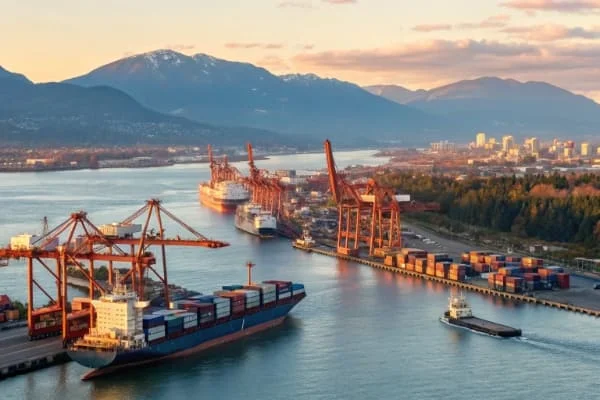
Feeling stressed about shipping costs from China to the USA1? Past price spikes and tariff talks make budgeting hard. But 2025 looks much more stable and affordable for your business.
In 2025, shipping from China to the USA is stabilizing. Expect sea freight2 for a full container (FCL) to be $2,000–$4,500. Less-than-container (LCL) costs around $300–$500 per CBM. Air freight ranges from $4–$8 per kg, depending on various factors we will explore.
The crazy shipping prices of the pandemic are finally gone. I remember clients paying over $20,000 for a single container. It was a stressful time for everyone. Now, things are back to a predictable normal. We have served over 10,000 Amazon sellers, helping them navigate these exact changes. Even with political talk about new tariffs3, our clients are not leaving the Chinese market. In fact, many are coming to the Canton Fair4 to find even more suppliers. This shows their confidence in China's strong supply chain. But what exactly determines the final price you pay? Let's look at the details.
What Factors Affect China–US Freight Rates?
Confused why your shipping quotes are always different? Surcharges and hidden costs can eat into your profits. I'll show you the main factors that control your final freight bill.
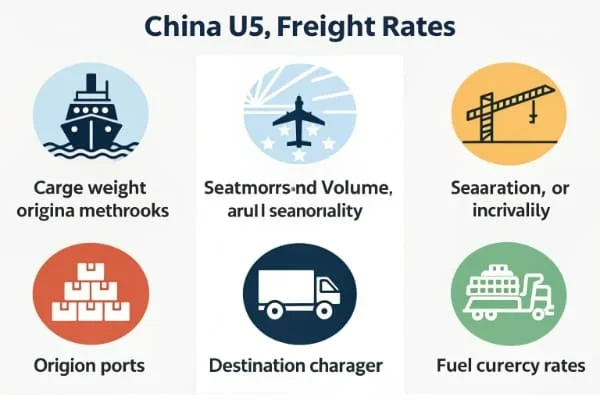
The main factors affecting China-US freight rates are shipping method5 (sea/air), cargo weight and volume6, origin and destination ports, and seasonality7. Incoterms8, fuel surcharges9 (BAF), and currency exchange rates also play a significant role in your final cost.
Getting a handle on these factors is key to managing your budget. It's not just about the base rate quoted by a carrier. You have to consider the total cost from the factory door to your US warehouse. A lot of our clients get worried about tariffs3 from the US-China trade war. This is a real concern, but it's important to separate tariffs3 (a tax on the goods) from freight (the cost of transport). The good news is that the freight cost itself has become much more predictable. Even with political noise, the underlying logistics network remains strong and efficient.
The Incoterms8 you agree on with your supplier have a huge impact. If you buy on EXW (Ex Works) terms, you are responsible for all costs from the factory. If you use FOB (Free On Board), the supplier pays to get the goods to the origin port. Understanding this difference is critical for accurate quoting. Here’s a simple breakdown of the main cost drivers:
| Factor | How It Affects Your Cost |
|---|---|
| Shipping Method | Sea freight is cheaper for bulk but much slower (30-45 days). Air freight is very fast (5-10 days) but costs significantly more per kilogram. |
| Cargo Size & Weight | Carriers charge based on chargeable weight10. This is the greater of the actual weight or the volumetric weight. Bulky, light items can be expensive. |
| Seasonality | Peak seasons like the pre-Christmas rush (August-October) and pre-Chinese New Year have higher rates and tighter capacity. Plan ahead to avoid these spikes. |
| Incoterms8 | Terms like FOB or EXW determine who pays for which part of the journey. This can shift thousands of dollars in responsibility between you and the supplier. |
| Surcharges | Carriers add surcharges9 for fuel (BAF), peak season (PSS), and general rate increases (GRI). These are variable and can change monthly. |
How Do Pallet Size and Weight Influence Shipping Cost?
Paying too much for your pallet shipments11? Incorrect dimensions can lead to unexpected overage fees from carriers. Let's look at how to optimize your pallets and save money.
Carriers charge based on "chargeable weight10," which is the greater of the actual weight and the volumetric (or dimensional) weight. For sea freight2 LCL, this is measured in Cubic Meters (CBM). For air freight12, the formula is usually (L x W x H in cm) / 6000.
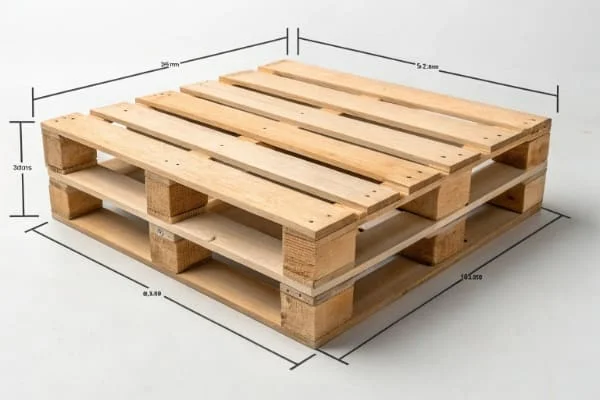
Understanding chargeable weight10 is one of the most important lessons in logistics. I've seen clients get hit with high costs because their products were light but very bulky. For example, a large box of foam pillows might only weigh 10 kg, but its volumetric weight could be 30 kg. The airline will charge you for 30 kg, not 10 kg. This is why smart packaging is so important. We always advise our clients to use compact packaging and stack pallets efficiently to reduce any unused space. This simple step minimizes the CBM for sea freight2 and the volumetric weight for air freight12. A small change in carton size can save you hundreds or even thousands of dollars on a single shipment.
Let's look at a real example. Imagine you have 100 cartons to ship. Each carton is 50cm x 40cm x 30cm and weighs 8 kg.
- Actual Weight: 100 cartons x 8 kg/carton = 800 kg.
- Volumetric Weight (Air): (50 x 40 x 30) x 100 cartons / 6000 = 1,000 kg. In this case, you would be charged for 1,000 kg for air freight12, not 800 kg. For sea freight2, the calculation is about volume.
- Total Volume (Sea): (0.5m x 0.4m x 0.3m) x 100 cartons = 6 CBM. You would pay the LCL rate based on 6 CBM.
| Metric | Air Freight | Sea Freight (LCL) |
|---|---|---|
| Unit of Measure | Volumetric Weight (kg) | Cubic Meter (CBM) |
| Calculation | The greater of actual weight or (L x W x H in cm) / 6000. | Total volume in cubic meters (L x W x H in meters). |
| Optimization Tip | Reduce package size and eliminate empty space inside boxes to lower volumetric weight. | Stack goods tightly on pallets and use standard-sized cartons to reduce total CBM. |
When Is Air Freight Cheaper Than Sea Freight?
Think sea freight2 is always the cheapest way to ship? This common belief can actually cost you more on small shipments. Let's find out when flying your goods is cheaper.
Air freight can be cheaper than sea freight2 for small, lightweight shipments, typically under 150-200 kg. This is because sea freight2 has high fixed costs13 for documentation and port handling, which make very small LCL shipments uneconomical. Air freight has lower minimum charges.
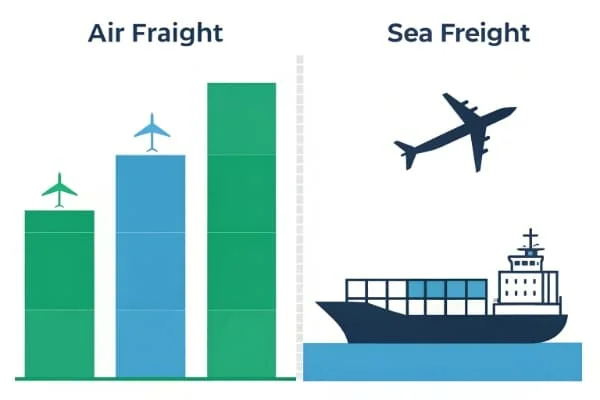
This surprises many of our new clients. They see a low per-CBM rate for LCL sea freight2 and assume it's the best deal. But for a very small shipment, like 50 kg or 0.5 CBM, the fixed costs13 kill the deal. For any LCL shipment, you have to pay for terminal handling, documentation, customs clearance, and warehouse fees at both the origin and destination ports. These fixed costs13 can easily add up to $300-$500 before the ocean freight is even included. For a tiny shipment, these fees make the total cost higher than air freight12. Air freight has fewer fixed fees and a lower minimum billable weight, making it the winner for small quantities.
Beyond cost, think about speed. For high-value electronics, seasonal fashion, or urgent restocks for your Amazon store, getting your product to market 30 days faster is a huge advantage. The extra air freight12 cost is an investment in sales. This is part of why China's supply chain is so powerful and flexible. We had a few clients look at sourcing from other countries like Vietnam or Brazil. They found that while product costs were sometimes similar, the shipping was a big problem. One client told me his sea freight2 quote from Vietnam was 15% more expensive and took an extra week because there were fewer ships available. The mature, high-volume logistics infrastructure14 in China gives you reliable and cost-effective options for any shipment size.
| Scenario | Best Shipping Method | Reason |
|---|---|---|
| Shipment < 150 kg | Air Freight | Lower minimum charges and fixed fees make it more economical than LCL sea freight2. Plus, it's much faster. |
| Shipment 150 kg - 15 CBM | LCL Sea Freight | This is the sweet spot for sea freight2. You get a good balance of cost and volume for medium-sized shipments. |
| Shipment > 15 CBM | FCL Sea Freight | A full container (20ft or 40ft) offers the lowest cost per CBM for any large shipment. You pay a flat rate for the whole box. |
| High-Value/Urgent Goods | Air Freight | Speed to market is critical. The higher shipping cost is justified by quicker sales and lower inventory holding costs. |
Conclusion
Shipping from China in 2025 is affordable and stable. By understanding freight factors and choosing the right method for your shipment's size, you can effectively manage your supply chain costs.
Explore this link to understand the latest shipping costs and how they impact your business budget. ↩
Learn about sea freight to make informed decisions for bulk shipping and cost management. ↩
Explore the implications of tariffs on your shipping costs and how to navigate them effectively. ↩
Discover how attending the Canton Fair can help you find suppliers and expand your business network. ↩
Learn about various shipping methods to choose the best option for your business needs. ↩
Discover how understanding weight and volume can help you optimize shipping expenses. ↩
Learn about seasonal trends in shipping to better plan your logistics and avoid high costs. ↩
Learn about Incoterms to ensure you understand your responsibilities in international shipping. ↩
Get insights into surcharges that can affect your shipping costs and how to plan for them. ↩
Understand chargeable weight to avoid unexpected fees and optimize your shipping strategy. ↩
Explore tips for optimizing pallet shipments to reduce costs and improve efficiency. ↩
Understand the benefits of air freight for urgent shipments and how it can impact your delivery times. ↩
Understand fixed costs in shipping to better manage your budget and pricing strategies. ↩
Explore the significance of logistics infrastructure in ensuring efficient shipping operations. ↩