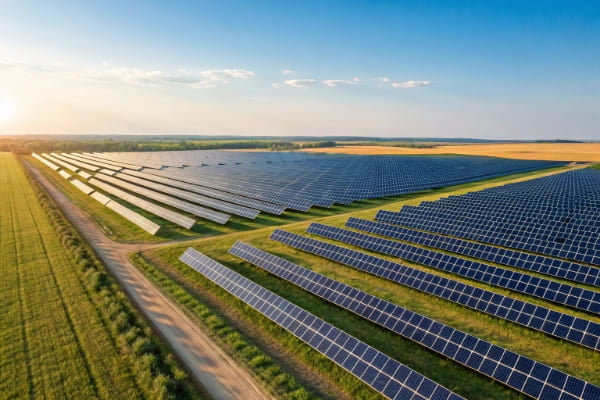
You see massive solar farm1s, but the process seems complex. You're curious how they power entire cities. This complexity makes it hard to grasp their true potential.
Utility-scale solar energy2 works by using vast fields of photovoltaic (PV) panels3 to capture sunlight and convert it into direct current (DC) electricity4. This DC power is then changed to alternating current (AC)5 by inverters6 and sent to the power grid for distribution to homes and businesses.
That's the quick answer, but there's so much more to it. In my line of work, I deal with large-scale projects and manufacturing, and the engineering behind these solar farm1s is truly impressive. Let's break down each step of the process to see how it all comes together. Understanding these details is key to appreciating their role in our energy future.
What Is Utility-Scale Solar Energy?
You hear the term "utility-scale solar," but it sounds like jargon. It's different from rooftop panels, but how? This confusion can make it seem unapproachable and distant.
Utility-scale solar energy2 refers to very large solar power plants7, often covering hundreds of acres. They generate enough electricity to sell directly to a utility company, which then distributes it to many customers. These projects are designed for massive, centralized power generation for the grid.

When we talk about utility-scale, we are talking about a completely different class of project compared to the panels on a neighbor's roof. In my experience sourcing components for large infrastructure, the principle of "economies of scale8" is everything, and it applies perfectly here. Utility-scale projects leverage their massive size to lower the cost of electricity.
Defining the Scale
These projects are defined by their capacity, measured in megawatts (MW)9. While a home might have a 5-kilowatt system, a utility-scale plant can be over 100 MW—enough to power a small city. They achieve this by purchasing panels, inverters6, and other hardware in huge volumes, driving down the per-unit cost. This bulk procurement is a key reason solar has become so competitive with traditional energy sources.
The Goal: Powering the Grid
Unlike rooftop solar, which primarily powers the building it's on, the sole purpose of a utility-scale plant is to feed electricity directly into the high-voltage transmission10 grid. It acts as a centralized power station, just like a coal or natural gas plant.
Key Differences from Rooftop Solar
The table below breaks down the major differences I've seen. The core distinction is the customer: a homeowner versus a power company. This changes everything from the engineering to the economics of the project.
| Feature | Residential Solar | Commercial Solar | Utility-Scale Solar |
|---|---|---|---|
| Size | 5-20 kW | 20 kW - 1 MW | > 1 MW (often 100+ MW) |
| Location | Rooftops | Rooftops, Carports | Large land areas |
| Customer | Homeowner | Business/Organization | Utility Company |
| Connection | Behind-the-meter | Behind-the-meter | Directly to grid |
| Cost | Higher $/watt | Medium $/watt | Lower $/watt |
How Do Utility-Scale Solar Power Plants Generate Electricity?
A field of panels seems simple. But how does sunlight become usable power? The science behind it feels hidden, making the entire process seem a bit like magic.
Solar power plants generate electricity using the photovoltaic effect11. When sunlight hits the solar panels, it excites electrons in the silicon cells, creating a flow of direct current (DC) electricity4. Thousands of these panels are linked together to produce a massive amount of DC power.
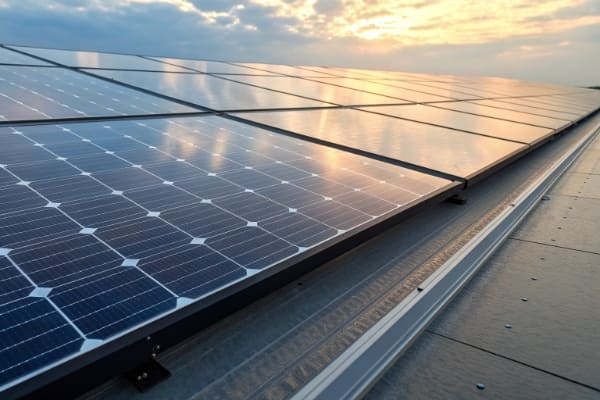
The fundamental process is beautifully simple, yet scaling it up is an engineering feat. I've seen firsthand how tiny components, when sourced and assembled correctly, can create something incredibly powerful. A solar farm1 is a perfect example of this.
The Photovoltaic Effect Explained
At the heart of every solar panel are photovoltaic (PV) cells, usually made from silicon. When photons from sunlight strike a cell, they transfer their energy to electrons. This energy allows the electrons to break free and flow, creating an electrical current. This is the photovoltaic effect11, and it's a direct conversion of light into electricity with no moving parts. It's a silent, clean, and highly reliable process.
From Cell to Array
A single PV cell doesn't produce much power. So, manufacturers wire many cells together to create a solar panel, also called a module. On a utility-scale farm, thousands of these panels are then wired together in series and parallel to form a "solar array12." Connecting them in series increases the voltage, while connecting them in parallel increases the current. The goal is to produce a massive, combined flow of DC electricity at a specific voltage that the plant's equipment is designed to handle. This modular approach makes the system scalable and easier to maintain.
How Is Solar Power Converted from DC to AC?
Solar panels make DC power, but our homes and grids use AC power. How does the switch happen? This critical step is often overlooked, leaving a gap in understanding.
Solar power is converted from DC to AC using large devices called central inverters6. The DC electricity from the solar panels flows into these inverters6, which use electronic switches to change the current into the alternating current (AC)5 waveform that the power grid uses.
The inverter is the brain of the solar power plant. While panels get all the attention, the inverter does the heavy lifting to make the power usable. In sourcing, we know that a system is only as strong as its most critical component, and for a solar farm1, the inverter is it.
The Role of the Central Inverter
Utility-scale plants use huge central inverters6 that can handle megawatts of power from thousands of panels. These devices take the raw DC input and, using powerful electronics, chop it up and reshape it into a clean sine wave of alternating current (AC)5. The frequency of this AC power (usually 60 Hz in North America or 50 Hz elsewhere) must perfectly match the frequency of the electrical grid. This synchronization is critical for the power to be accepted by the grid.
Modern Inverters and Grid Support
Today's "smart" inverters6 do more than just convert power. They are essential for maintaining a stable power grid. As more solar comes online, grid operators need these resources to help manage voltage and frequency. Advanced inverters6 can inject or absorb power to stabilize voltage, a service that was traditionally provided by fossil fuel plants. This makes the solar farm1 an active participant in grid health13, not just a passive generator.
How Does Electricity Travel from Solar Farms to the Grid?
The power is generated, but the farm is often far from cities. How does it get to your home? The long journey of electricity seems complex and potentially inefficient.
After conversion to AC, the electricity goes to a transformer14 at the solar farm1's substation. The transformer14 increases the voltage significantly. This high-voltage power is then sent through transmission lines to connect with the regional power grid, minimizing energy loss over long distances.
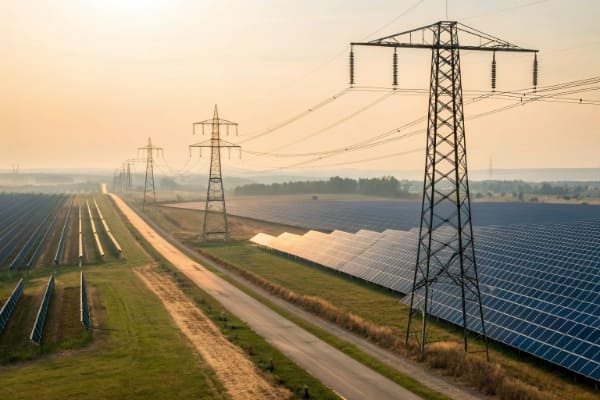
Getting the product from the factory to the customer is my daily job in logistics. In the energy world, the "product" is electricity, and the "customer" is the grid. The principles of efficient transport are the same.
The On-Site Substation
Every utility-scale solar farm1 has its own substation. This is the connection point between the solar farm1 and the wider world. The AC power from all the central inverters6 is collected here. The substation contains switchgear for safety and control, as well as the all-important transformer14. It's the central hub for dispatching the electricity.
Stepping Up the Voltage
The key to moving power over long distances is high voltage. Power loss during transmission is proportional to the square of the current (I²R loss). By increasing the voltage, you can decrease the current for the same amount of power (Power = Voltage x Current). The large transformer14s at the substation "step up" the voltage from a medium level to a very high transmission level, often hundreds of thousands of volts. This allows the electricity to travel for many miles with very little energy lost as heat, ensuring that the clean energy15 generated reaches homes and businesses efficiently.
How Much Electricity Can a Utility-Scale Solar Plant Produce?
You see a huge solar farm1 and wonder about its impact. Is it enough to power a town or a city? The actual output is often an abstract number for most people.
A large utility-scale solar plant, around 100 megawatts (MW)9, can produce enough electricity to power tens of thousands of homes. The exact output depends on its size, location, technology used, and local weather patterns. These plants are major contributors to the energy supply.

In business, we always ask about the return on investment. For a solar farm1, the return is the amount of clean, valuable electricity it can generate over its lifetime. The numbers are impressive and are a big reason we see so many of these projects being built.
Understanding Megawatts and Megawatt-Hours
A plant's size is its capacity, measured in megawatts (MW)9. This is its maximum power output at any given moment. Its actual energy production is measured in megawatt-hours (MWh) over a period, like a day or a year. For example, a 100 MW plant in a sunny location might produce around 250,000 MWh per year. For context, the average U.S. home uses about 10 MWh per year, so that single plant could power approximately 25,000 homes.
The Economics: Levelized Cost of Electricity (LCOE)16
The real game-changer for utility-scale solar is its low cost. By leveraging economies of scale8 in manufacturing, construction, and operations, these plants achieve a very low Levelized Cost of Electricity (LCOE)16. LCOE represents the average revenue per unit of electricity generated that would be required to recover the costs of building and operating a generating plant over its lifetime. For new utility-scale solar projects, this cost is now often lower than that of new coal or gas plants, making it the most economical choice for new power generation in many parts of the world.
What Technologies Are Used in Utility-Scale Solar Projects?
Not all solar farm1s are the same. Some panels move, others don't. What tech choices make one plant better than another? This lack of detail can be confusing.
Utility-scale projects use advanced technologies to maximize output. This includes solar tracking systems17 that follow the sun, high-efficiency photovoltaic panels, and sophisticated monitoring software (SCADA) to manage the entire plant in real-time.
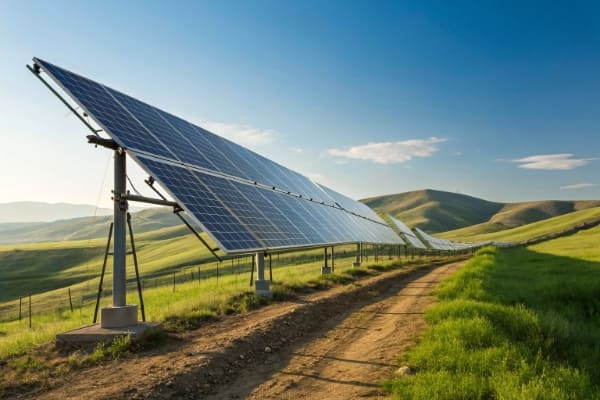
Getting the best performance requires using the right technology. It's the same in manufacturing as it is in energy production. In my field, we constantly evaluate new tools and processes to improve efficiency. Solar developers do the same to squeeze every possible watt out of their investments.
Solar Tracking Systems: Following the Sun
One of the most impactful technologies is the solar tracker. Instead of being fixed in place, panels are mounted on systems that move to follow the sun's path across the sky. This keeps the panels at the optimal angle to receive direct sunlight throughout the day, significantly boosting energy production. Single-axis trackers, which follow the sun from east to west, are the most common in utility-scale projects. They can increase a plant's annual energy output by 15-25% compared to a fixed system.
Centralized Monitoring and Control (SCADA)
A utility-scale farm is a complex machine that needs constant oversight. This is handled by a SCADA (Supervisory Control and Data Acquisition) system. It's a centralized software platform that allows operators to monitor everything in real-time—from the output of a single panel string to the temperature of an inverter. This allows for predictive maintenance, rapid fault detection, and optimized performance, minimizing downtime and maximizing energy yield18 over the plant's 25+ year lifespan.
| System Type | Description | Energy Gain (vs. Fixed) | Cost & Complexity |
|---|---|---|---|
| Fixed-Tilt | Panels are stationary at an optimal angle. | Baseline | Lower |
| Single-Axis Tracker | Panels rotate on one axis, east to west. | +15-25% | Medium |
| Dual-Axis Tracker | Panels move on two axes to always face the sun. | +30-40% | Higher |
Do Utility-Scale Solar Plants Work on Cloudy Days?
Solar panels need sun. So what happens when it's cloudy or raining? Many assume production stops completely, creating doubts about solar's reliability on overcast days.
Yes, utility-scale solar plants still produce electricity on cloudy days19, just less of it. Panels can generate power from indirect or diffused sunlight. While output is lower than on a clear day, they do not shut down completely and continue to feed power into the grid.
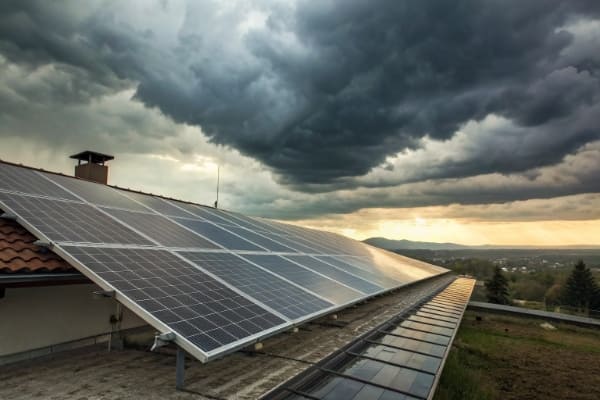
Thinking that solar panels need perfect, direct sunlight to work is a common misconception. In reality, they are more resilient than many people think. We often have to plan for variable conditions in global shipping, and grid operators do the same for variable energy sources like solar.
Direct vs. Diffused Sunlight
On a clear day, panels receive "direct irradiance"—sunlight that travels in a straight line. On a cloudy day, sunlight is scattered by clouds and water vapor in the atmosphere. This is called "diffused irradiance." PV panels are designed to capture both. While the energy intensity is lower, they still produce a significant amount of power. For example, on a heavily overcast day, a plant might produce 10-25% of its rated capacity.
Grid Management of Variable Power
Grid operators are experts at managing fluctuations in supply and demand. They use advanced weather forecasting to predict solar output hours and even minutes in advance. When they expect a drop in solar production due to cloud cover, they can ramp up other power sources, like natural gas plants or hydropower, to fill the gap. The sheer geographic size of a utility-scale plant also helps, as a single cloud will likely not cover the entire array at once, smoothing out the overall output.
Can Utility-Scale Solar Provide Power at Night?
The sun sets every day. How can solar power be a 24/7 solution? This fundamental limitation makes many people skeptical about its role as a primary power source.
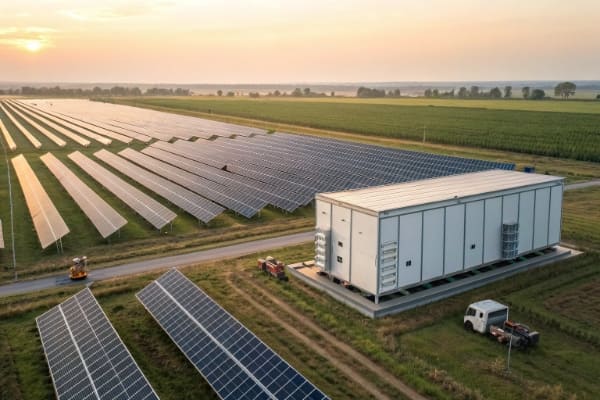
By themselves, solar plants cannot generate power at night. However, many modern utility-scale projects are paired with large battery energy storage systems (BESS). These batteries store excess energy generated during the day and release it to the grid after sunset, providing power at night.
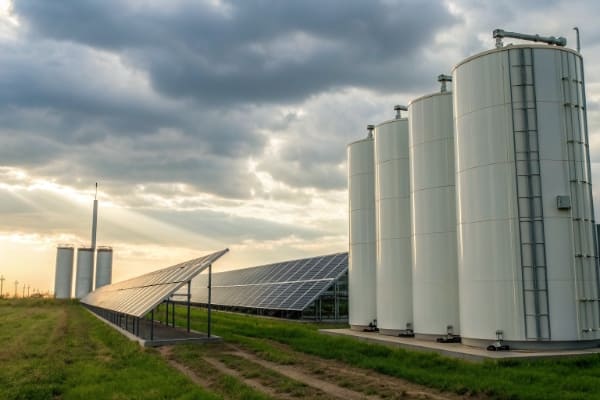
This is the final piece of the puzzle and, in my opinion, the most exciting development. In supply chain management, warehousing and inventory are key to meeting demand anytime. Batteries serve the exact same function for electricity: they store the supply to be used when needed.
The Role of Battery Energy Storage Systems (BESS)
Modern utility-scale solar projects are increasingly being built as "solar-plus-storage" plants. These projects co-locate massive banks of lithium-ion batteries right next to the solar arrays. During the sunny middle of the day, when solar production is highest, any electricity not needed by the grid is used to charge these batteries.
Storing Daytime Power for Nighttime Use
As the sun sets and solar production drops, the BESS springs into action. It begins discharging its stored energy into the grid, replacing the power that the solar panels were providing. This allows the plant to continue supplying clean energy for several hours after dark, often through the entire evening peak demand period. This "time-shifting" of solar energy transforms an intermittent resource into a reliable, dispatchable one that grid operators can count on 24/7, fundamentally changing the role solar can play in our energy system.
Conclusion
Utility-scale solar uses vast panel arrays and advanced technology to power the grid. With integrated battery storage, it is becoming a reliable, 24/7 source of clean energy.
Learn about the operation and significance of solar farms in energy production. ↩
Explore this link to understand the fundamentals of utility-scale solar energy and its significance in modern power generation. ↩
Learn about the technology behind PV panels and their role in solar energy production. ↩
Discover the importance of DC electricity in solar power systems and its conversion process. ↩
Understand the role of AC in the power grid and how it relates to solar energy. ↩
Find out how inverters convert DC to AC and their critical role in solar energy. ↩
Learn about the various configurations and technologies used in solar power plants. ↩
Explore how economies of scale impact the cost and efficiency of solar energy production. ↩
Learn about the measurement of power output in solar plants and its significance. ↩
Explore the process of transmitting solar energy over long distances efficiently. ↩
Learn about the science behind how solar panels generate electricity. ↩
Understand the structure and function of solar arrays in utility-scale solar farms. ↩
Explore the active role of solar energy in maintaining a stable power grid. ↩
Discover how transformers are used to increase voltage for efficient energy transmission. ↩
Explore the benefits of clean energy and the role of solar power in sustainability. ↩
Understand LCOE and its implications for the economics of solar energy. ↩
Discover the technology behind solar trackers and their benefits for solar farms. ↩
Understand the variables that influence the efficiency and output of solar energy. ↩
Find out how solar panels perform under different weather conditions. ↩